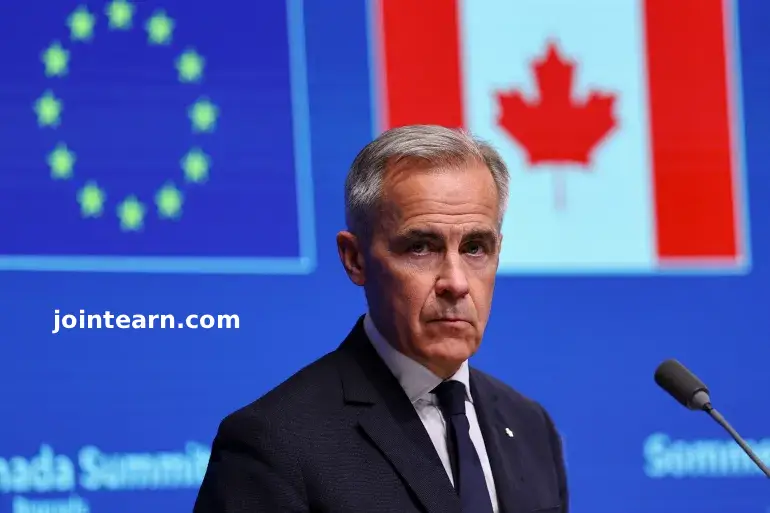
Canada has officially become the first non-European nation to join the European Union’s major new defence rearmament initiative, marking one of the country’s most significant military and geopolitical shifts in decades. The move signals Prime Minister Mark Carney’s intention to diversify Canada’s defence partnerships and reduce its longstanding dependence on the United States.
The announcement was made on Monday, with Carney confirming that Canada will participate in the EU’s Security Action for Europe (SAFE) programme—a €150 billion (about $170 billion) defence fund designed to rapidly strengthen Europe’s military production and preparedness.
A Strategic Pivot Toward Europe
Carney said the partnership opens the door to “tremendous opportunities” for Canadian defence companies by giving them greater access to European markets at a moment when global tensions are rising.
“Canada’s participation in SAFE will fill key capability gaps, expand markets for Canadian suppliers, and attract European defence investment into Canada,” he said.
In a joint statement with European Commission President Ursula von der Leyen, Carney described the agreement as the latest step in deepening Canada–EU cooperation, especially as both sides confront growing geopolitical risks.
SAFE: Europe’s Push for Self-Reliance
The SAFE fund was created in response to increased fears among EU nations about a potential military threat from Russia, as well as concerns over whether the United States can be consistently relied upon for security commitments.
The initiative aims to accelerate defence manufacturing, strengthen procurement networks, and ensure the EU can defend itself by 2030. Funding will support priority capabilities such as:
- missile and ammunition production
- artillery systems and ground combat equipment
- drones and anti-drone systems
- cyber capabilities
- electronic warfare technology
- maritime and air defence systems
- protection of satellites and space-based assets
Most SAFE-funded projects must source at least 65 percent of their components from within the EU’s 27 member states. However, exemptions are expected for trusted partners like Canada.
Why Canada Is Moving Away from the US
Canada’s decision reflects a broader attempt to reduce its reliance on American military suppliers. Carney previously stated that more than 70 percent of Canadian military capital spending would no longer flow to the US—an unprecedented shift considering decades of close economic and defence integration.
The change comes after a turbulent year in Canada–US relations. Earlier in 2025, US President Donald Trump launched a trade war targeting Canadian products and publicly suggested that Canada should become the “51st state,” sparking outrage across the country.
Joining SAFE gives Canada an alternative defence ecosystem—one less vulnerable to sudden political swings in Washington.
A Growing Divide in Western Defence Politics
While the EU welcomed Canada’s participation, negotiations with the United Kingdom over joining SAFE collapsed the previous week. Talks reportedly broke down over financial disagreements, with the EU demanding higher contributions than the UK was prepared to pay.
Canada’s inclusion, meanwhile, strengthens its ties with Europe at a moment when Western alliances are being reshaped by economic instability, election results, and shifting military priorities.
By aligning more closely with the EU on defence production, Canada positions itself as a transatlantic bridge—even as it distances itself from US-led procurement structures.


Leave a Reply