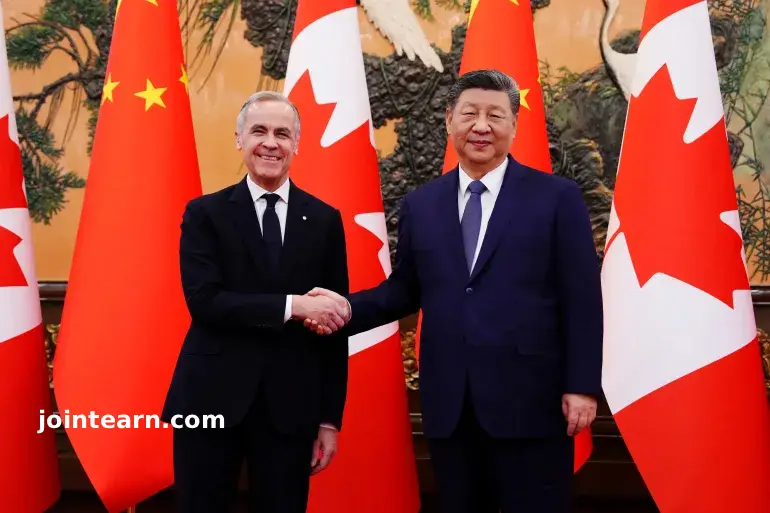
Beijing, China – Canadian Prime Minister Mark Carney made a historic visit to China on Friday, aiming to reset relations with Beijing after years of tension and trade disputes. Meeting with Chinese President Xi Jinping at the Great Hall of the People, Carney emphasized the need for closer cooperation and a renewed “strategic partnership” between the two countries.
Leaders Pledge to Improve Canada-China Ties
During their discussions, Xi said he is committed to restoring and strengthening ties with Canada, following an initial meeting in October 2025 on the sidelines of a regional economic conference in South Korea.
“It can be said that our meeting last year opened a new chapter in turning China–Canada relations towards improvement,” Xi said.
Carney, the first Canadian prime minister to visit China in eight years, echoed Xi’s sentiment, highlighting that enhanced bilateral cooperation could help stabilize a global governance system under great strain.
“Together we can build on the best of what this relationship has been in the past to create a new one adapted to new global realities,” Carney said, addressing Xi.
“Engagement and cooperation will be the foundation of our new strategic partnership.”
Focus Areas: Agriculture, Energy, and Finance
Carney outlined sectors where Canada and China could achieve immediate progress, including agriculture, energy, and finance. These areas are seen as critical to reducing economic reliance on the United States, particularly amid ongoing trade disruptions and US-imposed tariffs.
“We are focused on building an economy less reliant on the US at a time of global trade disruption,” Carney said, noting meetings with leading Chinese companies during his Beijing trip.
The reference to “new global realities” reflects the so-called America First approach of US President Donald Trump, whose trade policies have placed additional strain on Canadian and Chinese economies.
The Tariff Dispute Remains Unresolved
No new announcements were made regarding tariffs between Canada and China, a longstanding point of contention. Under former Canadian Prime Minister Justin Trudeau, Canada implemented tariffs of 100 percent on Chinese electric vehicles (EVs) and 25 percent on steel and aluminium. In response, China imposed duties of:
- 100% on Canadian canola oil and meal
- 25% on pork and seafood
- 75.8% on canola seeds (added in August 2025)
These measures effectively restricted Canadian access to the Chinese canola market, a key export for the country.
China has indicated that US pressure on allies, including Canada, may push them toward a foreign policy less aligned with Washington, a concern highlighted by Trump’s past remarks suggesting Canada could be the US’s 51st state.
Strategic Implications for Canada
Carney’s visit signals a shift toward pragmatic engagement with Beijing, balancing the need for stronger economic ties against ongoing US-China tensions. Analysts note that Canada is seeking to diversify trade partners and strengthen diplomatic channels, particularly in sectors vital to its economy, such as agriculture, clean energy, and financial services.
“Building a strategic partnership with China allows Canada to navigate global uncertainty and mitigate the impact of US tariffs,” said a Canadian trade analyst.
While tariff issues remain unresolved, both leaders underscored the importance of dialogue, economic cooperation, and collaboration on global challenges, positioning this visit as a potential turning point in Canada-China relations.


Leave a Reply