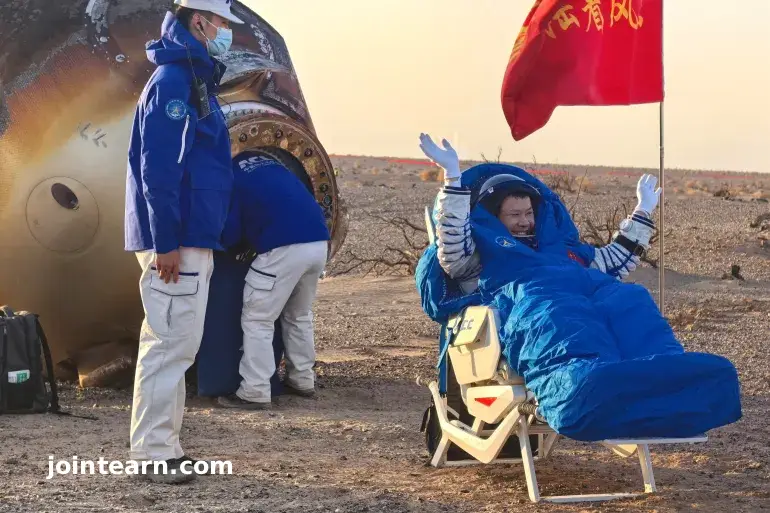
In an unprecedented emergency operation, China has successfully launched an uncrewed spacecraft to rescue three astronauts stranded aboard the Tiangong space station. The astronauts were left without a functioning return capsule after their original vehicle, Shenzhou-20, was damaged by debris, making it unsafe for re-entry to Earth.
The mission demonstrates China’s rapid response capabilities in space exploration and underscores the country’s growing influence in the global space race.
Emergency Launch: Shenzhou-22 Takes Off
State media reported that the Shenzhou-22 spacecraft was launched atop a Long March-2F rocket from the Jiuquan Satellite Launch Centre shortly after noon local time (04:00 GMT) on Tuesday. The mission, initially scheduled for 2026 as a crewed flight, was advanced due to the unexpected damage to Shenzhou-20.
This swift rescheduling highlights China’s ability to adapt its space operations under emergency conditions, ensuring the safety of astronauts aboard its permanently crewed space station, Tiangong.
Stranded Astronauts and the Space Safety Gap
The three taikonauts – Zhang Lu, Wu Fei, and Zhang Hongzhang – were originally scheduled to return to Earth via Shenzhou-20 after their six-month mission, which began in April 2025. With Shenzhou-20 deemed unfit for re-entry, the astronauts had no immediate return vehicle, prompting Beijing to launch the uncrewed Shenzhou-22 as a contingency.
Officials confirmed that the crew remains safe and “is working normally,” emphasizing that the emergency launch is a precautionary measure to guarantee a safe return if needed.
Implications for China’s Space Program
This rare setback for China’s space program comes amid its ambitious plans to send astronauts to the Moon by 2030. Beijing has invested billions into its space sector over the past decades, aiming to rival the space capabilities of the United States, Russia, and Europe.
China’s achievements include becoming the third country to send humans into orbit after the United States and the former Soviet Union, cementing its status as a major player in human spaceflight. The Shenzhou-22 mission not only addresses the immediate safety concerns but also demonstrates the country’s growing expertise in orbital operations and emergency response.
The Future of Chinese Space Missions
The Tiangong space station has been continuously crewed since its first modules were launched, serving as a key platform for long-term human spaceflight research. With missions like Shenzhou-22, China continues to expand its space exploration capabilities, showcasing advanced technology in space rescue operations and crewed orbital missions.
The emergency launch also serves as a reminder of the inherent risks of space travel and the importance of robust contingency planning. Analysts suggest that this event may accelerate China’s development of more resilient spacecraft for future missions to the Moon and beyond.


Leave a Reply