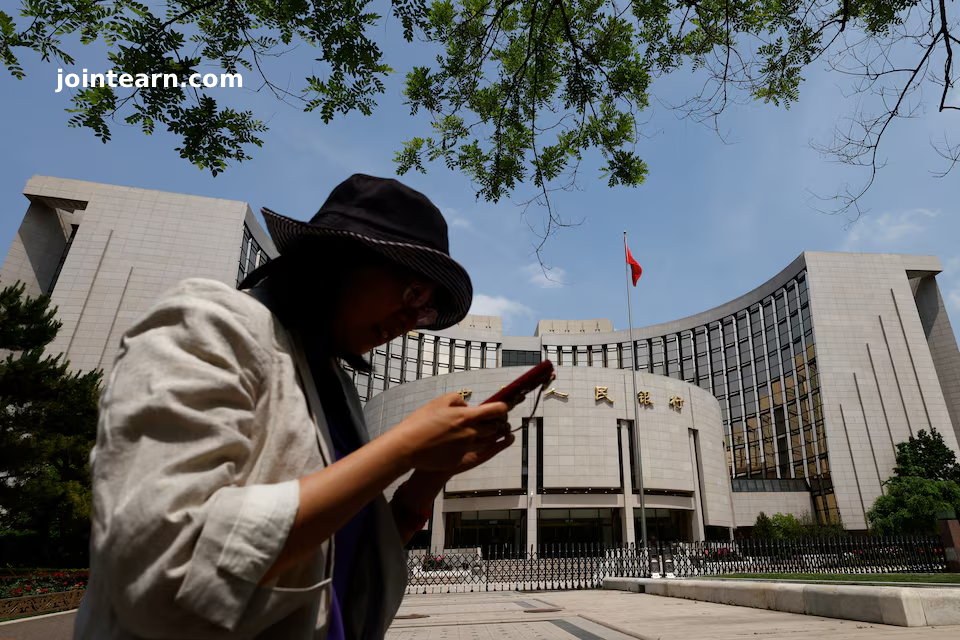
China’s central bank is expected to maintain its benchmark lending rates for a seventh consecutive month in December, signaling a cautious approach amid a slowing economy and ongoing challenges in the property sector. Analysts suggest that while the People’s Bank of China (PBOC) is not rushing to ease monetary policy, fresh interest rate cuts could come early in 2026 to support growth.
Lending Rates Expected to Remain Unchanged
A recent Reuters survey of 25 economists and market participants found unanimous expectations that the one-year and five-year loan prime rates (LPRs) will remain steady at 3.0% and 3.5%, respectively. These LPRs, set monthly by the PBOC based on proposals from 20 designated commercial banks, serve as benchmarks for most loans in China, including mortgages.
This follows the PBOC’s decision earlier this month to keep the seven-day reverse repo rate—the key policy rate underpinning LPRs—unchanged at 1.4%.
Economic Slowdown and Property Market Woes
China’s economy showed signs of stalling in November 2025, with slower growth in both factory output and retail sales. The lingering property sector crisis has dampened consumer and business sentiment, adding pressure on policymakers to balance economic support with financial stability.
Despite these challenges, China’s trade surplus exceeded $1 trillion in the first 11 months of 2025. However, exporters face a more difficult 2026 due to rising trade tensions and global uncertainty.
Banks Cautious on Rate Cuts
A key factor behind the PBOC’s reluctance to cut rates further is the impact on banks’ profitability. Record-low net interest margins, currently around 1.42%, would be squeezed by additional LPR reductions. Lower mortgage rates next year could further compress margins, making lending less attractive for banks.
“A cut in LPR now would reduce mortgage rates at the start of next year, which would make life more difficult for banks,” said a Shanghai-based banker, speaking on condition of anonymity.
Expectations for Early 2026 Easing
While rates are expected to remain steady in December, economists predict renewed easing in early 2026 to sustain economic growth. Citi analysts anticipate the PBOC could resume policy support as early as January, while ING forecasts a fresh wave of monetary stimulus in the early months of next year.
Other projections include:
- China Post Securities: Potential 20-basis-point cut in the first half of 2026.
- Citic Futures: Forecasts 10-20 basis points of rate reductions in 2026.
These anticipated cuts aim to support economic activity while maintaining financial stability in a delicate post-property crisis environment.
Conclusion
China’s decision to maintain benchmark lending rates for a seventh month reflects the PBOC’s cautious approach to monetary policy amid slowing economic growth and a struggling property market. While the economy is still on track to meet Beijing’s 2025 growth target of around 5%, analysts expect targeted rate cuts in early 2026 to help stimulate domestic demand and sustain momentum in key sectors, including real estate and exports.


Leave a Reply