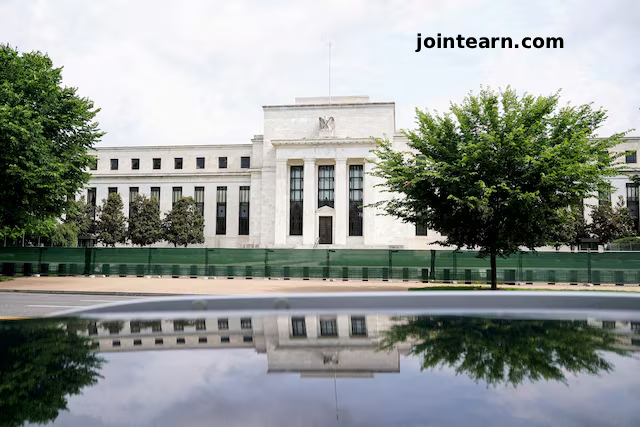
After nearly three years of operating at a financial loss, new data indicates that the U.S. Federal Reserve may have begun making money again. The shift marks a major turning point for the central bank, whose balance sheet was heavily strained by its pandemic-era policies and aggressive interest rate hikes aimed at fighting inflation.
Recent Federal Reserve reports show a notable change: the size of the central bank’s deferred asset—an accounting tool used to capture cumulative losses—has started to shrink for the first time since 2022. This development suggests that the Fed has resumed generating profits, though experts say it may take years before the bank can fully erase the losses and resume sending surplus earnings back to the U.S. Treasury.
A Small but Significant Shift in Fed Finances
Data covering early November through November 26 shows the Fed’s deferred asset declining from $243.8 billion to $243.2 billion. The change may appear minor, but it represents the first sustained decrease after years of steady accumulation.
This improvement implies the Federal Reserve is earning enough income—primarily from its enormous bond portfolio—to cover its operating costs and interest payments to financial institutions.
Economists believe the Fed’s 12 regional Reserve Banks together could generate over $2 billion in profit during the current quarter, according to Bill Nelson of the Bank Policy Institute.
Still, nobody expects a rapid turnaround. Analysts say it will likely take several years before the Fed eliminates its deferred asset and restores its typical practice of forwarding profits to the Treasury.
How the Fed Ended Up with Record Losses
The central bank’s losses originated from an unusual set of circumstances during and after the COVID-19 pandemic.
1. Massive bond-buying during the pandemic
To stabilize the economy, the Fed purchased vast amounts of Treasury and mortgage-backed securities—an effort to lower long-term interest rates and support lending.
Its balance sheet ballooned to $9 trillion by mid-2022, more than double its pre-pandemic size.
2. Sharp rate hikes to fight inflation
In 2022, as inflation surged, the Fed raised interest rates at the fastest pace in decades.
Higher rates forced the central bank to pay more interest to banks on reserves and to money-market funds through its reverse repo facility.
Unfortunately for the Fed, the interest it paid out began to exceed the interest it earned on its older, lower-yielding bond holdings. This mismatch pushed the central bank into loss-making territory beginning in September 2022.
Why the Fed’s Losses Are Now Shrinking
One key factor: interest rate cuts.
In 2023, interest rates peaked at 5.25%–5.5%. Today, the Fed has brought the federal funds target range down to 3.75%–4%, and more rate cuts are expected as officials grow concerned about the slowing job market.
Lower rates reduce the amount the Fed must pay banks to keep monetary policy functioning smoothly. As a result, the gap between the Fed’s earnings and expenses is narrowing—and appears to have flipped back into positive territory.
Analysts at LHMeyer note that the improvement began at almost the exact time the Fed reduced the interest on reserve balances (IORB) by 0.25 percentage points in October.
Economists, including Deutsche Bank’s Matthew Luzzetti, have pointed out that when market yields exceed the interest rate the Fed pays banks, the central bank’s losses naturally reverse.
Do These Losses Affect the Fed’s Policy Power?
Federal Reserve officials have repeatedly emphasized that profitability has no impact on their ability to carry out monetary policy. The central bank does not operate like a private business and cannot go bankrupt in the traditional sense.
However, some lawmakers have criticized the system that requires the Fed to pay interest to banks as part of its rate-setting framework. They argue that these payments amount to a subsidy for financial institutions—especially when the amounts are large.
Despite the political tensions, economists widely agree that the Fed’s financial position has no effect on its authority or independence in managing the economy.
What Happens Next?
Although the Fed appears to have stopped losing money, the path to fully eliminating its deferred asset will be slow. Financial experts expect the process to take multiple years, even under favorable economic conditions.
Only once the deferred asset is fully reduced to zero will the Federal Reserve resume sending its profits—often billions of dollars per year—to the U.S. Treasury, helping reduce the federal deficit.
For now, analysts see the recent shift as a critical milestone: a sign that the Fed’s finances are gradually stabilizing after a turbulent period marked by pandemic intervention, inflation, and rapid policy tightening.


Leave a Reply