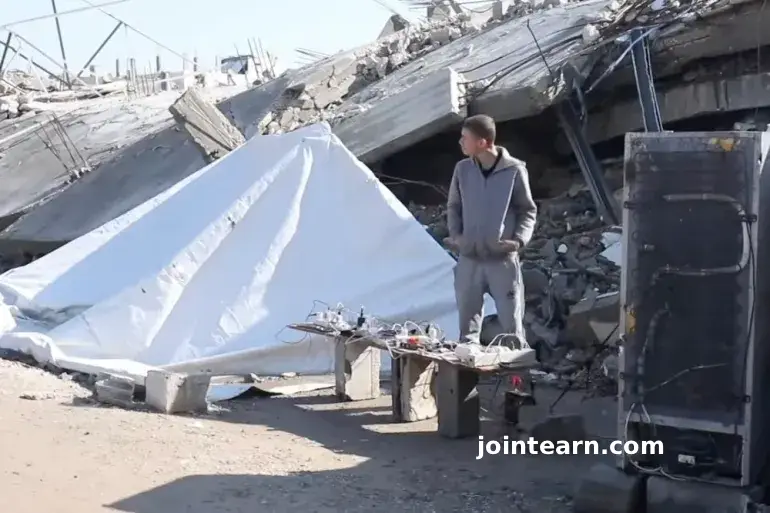
The Gaza Strip is facing an unprecedented economic crisis following more than two years of conflict with Israel. According to the United Nations, unemployment in Gaza has surged to 80 percent, one of the highest rates in the world, threatening the survival of thousands of households in the besieged territory.
Daily Survival Amid Devastation
Beyond the immediate humanitarian impact of mass death, displacement, and destruction of homes, hospitals, and schools, Gaza’s residents are struggling to maintain basic livelihoods. Formal employment opportunities have nearly vanished, forcing Palestinians to rely on small initiatives and informal businesses to support their families.
For widows like Um Mohammed al-Jarjawi, knitting has become a lifeline. Responsible for a household of five, she relies on her skills to provide for her grandchildren and trains the next generation in the craft.
“I started learning knitting when I was 10 years old,” al-Jarjawi told Al Jazeera. “After my husband passed away, I needed to support my household. I focused on working to provide for my family while improving my skills.”
Small-Scale Businesses Provide Fragile Relief
Across Gaza, small-scale businesses have emerged as temporary solutions to widespread unemployment. These include solar-powered phone-charging stations, women knitting baby clothes, and other micro-enterprises. While these ventures provide minimal income, they cannot restore economic stability or guarantee long-term employment.
Wasim al-Yazji operates a makeshift solar-powered charging station, providing a fragile lifeline for his family after his home, which previously housed a supermarket, was destroyed.
“I opened this charging station to help my family with basic needs, some food, and small expenses,” al-Yazji said. “But if the sun doesn’t shine, the charging power is weak, and I can’t work for days. Sometimes a whole week passes without any income.”
Power Shortages Worsen Economic Strain
Gaza’s electricity infrastructure has collapsed, with 70 percent of power networks destroyed. The lack of reliable electricity hampers both personal and commercial activity, leaving residents to improvise in order to survive.
The inability to secure stable work has left many residents idle, wandering streets, or waiting for temporary jobs that rarely materialize. Mohammed Shatat, a young Gaza resident, told Al Jazeera:
“I’ve been looking for a job for months. Even temporary work is hard to find. Every day feels the same… I go from place to place, asking, hoping, but there’s nothing.”
Humanitarian and Economic Outlook
Despite the resilience and ingenuity of Gaza’s residents, informal and small-scale initiatives cannot replace a functioning labor market. With hundreds of thousands still unemployed, the enclave faces one of the most severe economic crises in the world.
The United Nations warns that without urgent intervention and reconstruction, Gaza’s economic collapse will continue, leaving residents increasingly dependent on humanitarian aid and small survival initiatives.
Gaza Residents Adapt but Remain Vulnerable
Families are finding ways to survive in the face of devastation and destruction, but the reality remains stark. For many, daily life revolves around improvised income sources, highlighting the urgent need for international support to rebuild infrastructure, restore jobs, and stabilize the economy.


Leave a Reply