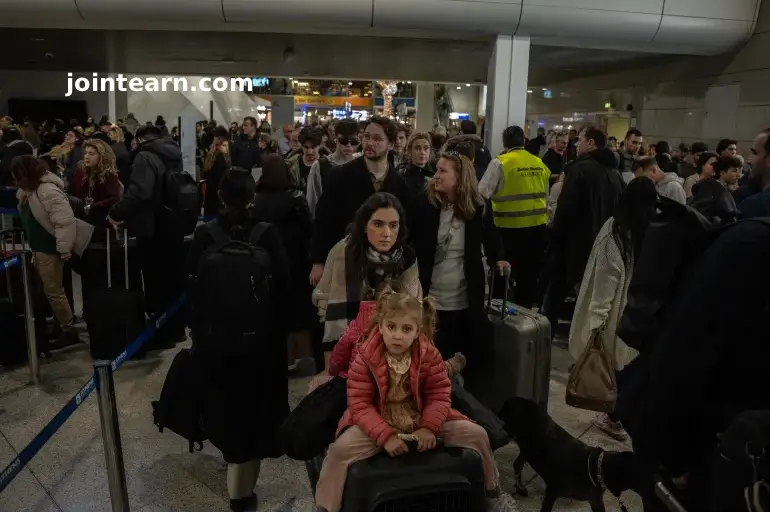
Air travel in Greece returned to normal on January 4, 2026, after a temporary shutdown of the country’s airspace caused widespread delays and stranded thousands of passengers. The disruption was triggered by a technical problem that knocked out aviation radio communications, leaving air traffic controllers unable to coordinate flights safely.
Air Traffic Comes to a Halt
The incident began just before 9 a.m. local time (07:00 GMT), when authorities detected massive interference across Greece’s aviation radio frequencies. As a precaution, flights were suspended at airports nationwide, including Athens’ Eleftherios Venizelos International Airport, Greece’s busiest airport.
“The ‘noise’ observed in the frequencies was in the form of continuous, involuntary emission,” the Hellenic Civil Aviation Authority (HCAA) said in a statement.
Passengers queued for hours at departure halls as authorities worked to assess the scope of the problem. The Association of Greek Air Traffic Controllers described the situation as “unprecedented and unacceptable,” emphasizing that all ground and approach frequencies were temporarily lost.
Causes and Immediate Response
Air traffic controllers cited aging infrastructure as a key factor that exacerbated the disruption. Panagiotis Psarros, chair of the controllers’ association, said:
“All frequencies were suddenly lost. There was no way to communicate with aircraft in the sky, and the old systems should have been replaced years ago.”
Limited services were gradually restored through backup channels by Sunday afternoon, allowing flights to resume in a controlled and safe manner. By late afternoon, around 45 flights were departing Greek airports every hour, according to officials.
Authorities Confirm Safety Was Never Compromised
Greece’s infrastructure and transport minister, Christos Dimas, assured the public that safety was never at risk during the incident. The HCAA highlighted that radar monitoring and ground-based separation protocols were maintained wherever possible.
The disruption affected a wide range of frequencies, including those managed by Athens Approach, the air traffic control unit responsible for guiding aircraft into and out of Eleftherios Venizelos International Airport. These frequencies are critical for monitoring aircraft speed, altitude, and separation, making the temporary outage a serious challenge for controllers.
Impact on Travelers and Airports
While services resumed by Sunday evening, thousands of travelers experienced significant delays. Athens’ airport alone handled 31.6 million passengers in the first 11 months of 2025, illustrating the scale of disruption when communication systems fail.
Passengers reported long waits in departure lounges and uncertainty about rescheduled flights. Officials stressed that all flights resumed safely, and no accidents occurred during the outage.
Calls for Infrastructure Upgrades
The air traffic controllers’ association has called for urgent modernization of Greece’s air traffic control systems, warning that outdated technology increases the risk of future incidents.
“This breakdown is a wake-up call. We must replace aging systems to avoid endangering passengers and ensure operational efficiency,” said Psarros.
The HCAA has pledged to investigate the cause of the interference and implement long-term improvements to the country’s aviation communication networks.


Leave a Reply