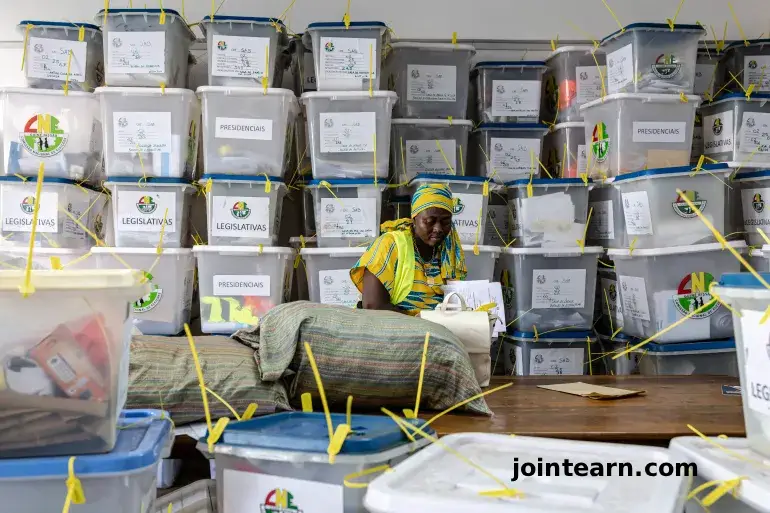
Bissau, Guinea-Bissau – Guinea-Bissau is facing political uncertainty as both incumbent President Umaro Sissoco Embalo and his main challenger, Fernando Dias, claimed victory in the presidential election before official results were released.
Each candidate asserted that they had surpassed the 50 percent threshold required to win outright, which would eliminate the need for a runoff election.
“We have won the presidential race. We will not have a second round,” Dias told supporters in the capital, Bissau, emphasizing that citizens were “tired” and seeking change.
Hours later, Embalo’s campaign also declared victory. Oscar Barbosa, the president’s spokesperson, insisted that there would be no runoff and urged rivals to avoid actions that could undermine the electoral process.
The National Electoral Commission has not yet commented on the conflicting claims but is expected to announce provisional results on Thursday.
Election Details
- The election featured 12 candidates, with voter turnout exceeding 65 percent.
- The African Party for the Independence of Guinea and Cape Verde (PAIGC), historically the country’s dominant political force, was barred from fielding a candidate for the first time.
- PAIGC endorsed Fernando Dias, who is standing for the Party for Social Renewal, boosting his campaign after support from former Prime Minister Domingos Simoes Pereira.
- Embalo, 53, is a former army general and ex-prime minister (2016–2018), seeking a second term – the first in 30 years for a sitting president in Guinea-Bissau.
Political Context
- Opposition parties argue that Embalo’s mandate should have ended earlier in 2025, but the Supreme Court ruled it extended until early September. The election was delayed to November.
- Embalo has dissolved parliament, dominated by opposition since the 2019 and 2023 legislative elections, and has blocked it from sitting since December 2023.
- Guinea-Bissau has a history of coups and attempted coups since independence, and half of its population lives in poverty, according to the World Bank.
International Oversight
Over 200 international observers monitored the electoral process, including representatives from:
- ECOWAS (Economic Community of West African States)
- African Union
- Community of Portuguese-speaking Countries
Observers will help ensure transparency amid tensions over the early victory claims.
Conclusion
As Guinea-Bissau awaits the official results, the nation faces a tense political standoff. Both campaigns’ early claims could fuel uncertainty and highlight the fragile state of democracy in a country with a history of instability.


Leave a Reply