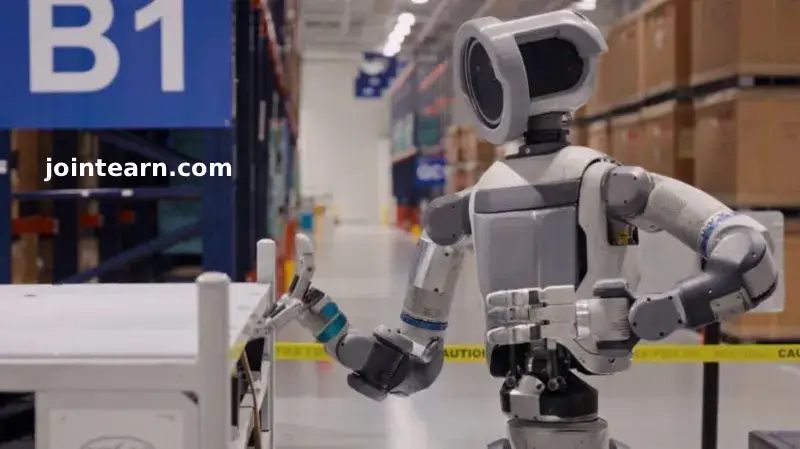
Hyundai Motor Group has announced plans to introduce human-like robots across its factories by 2028, signaling a major push toward automation and AI-driven manufacturing. The announcement was made during the Consumer Electronics Show (CES) in Las Vegas, where Hyundai showcased Atlas, a humanoid robot developed by Boston Dynamics, in which Hyundai holds a majority stake.
The move positions Hyundai alongside other global firms, including Amazon, Tesla, and BYD, who are also experimenting with humanoid robots to optimize factory operations.
Atlas Robots: Designed for Industrial Use
Hyundai described Atlas as a robot capable of performing a variety of industrial tasks, both autonomously and alongside human workers. Key features include:
- Assisting humans in physically demanding tasks.
- Performing potentially hazardous operations that could endanger employees.
- Managing machinery autonomously in factory environments.
- Learning from humans and adapting to complex workflows.
Hyundai emphasized that the robots are intended to complement human workers, not fully replace them, with roles such as robot training and supervision still requiring human expertise.
Global Deployment and US Investment
Hyundai plans to integrate Atlas robots across its global network, including a plant in Georgia, US, which gained attention after a massive immigration raid in 2025. The raid, which detained hundreds of workers, including South Korean nationals, sparked international controversy and prompted diplomatic interventions from President Lee Jae Myung of South Korea and US authorities.
In addition to robotics, Hyundai has committed over $20 billion in US investments to expand car production, autonomous driving technology, and AI applications.
Robotics Competition: Hyundai vs. Tesla
The announcement places Hyundai in direct competition with Tesla, whose Optimus humanoid robot has also been earmarked for industrial and manufacturing tasks. Both companies are racing to develop robots capable of performing complex, adaptive work in factory settings, while ensuring that human oversight remains integral.
Analysts note that Hyundai’s approach, leveraging Boston Dynamics’ expertise in humanoid mobility and manipulation, could give it a technological edge in deploying robots that work safely alongside humans.
Addressing Worker Concerns
Hyundai executives, including Vice Chair Jaehoon Chang, acknowledged concerns that automation could threaten jobs. They emphasized that humans will remain crucial for:
- Training and supervising robots
- Maintaining and programming robotic systems
- Performing creative and decision-making roles that robots cannot replicate
The company framed the robots as a way to reduce physical strain, improve safety, and increase efficiency, rather than as a direct replacement for human employees.
Strategic Implications
The integration of humanoid robots reflects Hyundai’s broader strategy to leverage AI and robotics in the automotive industry, enhancing productivity while reducing operational risks. The move is expected to:
- Accelerate manufacturing efficiency across Hyundai’s global plants.
- Strengthen Hyundai’s competitive position in autonomous vehicle production.
- Complement investments in battery production, autonomous driving, and AI systems.
By deploying humanoid robots like Atlas, Hyundai joins the growing wave of companies embracing next-generation robotics in industrial settings.
Looking Ahead
Hyundai’s plan to roll out Atlas robots by 2028 represents a significant milestone in the automation of car manufacturing. As robots take on more physically demanding and dangerous tasks, the company aims to maintain human oversight while improving safety and efficiency.
The move also signals the growing trend of AI integration into physical industries, alongside Nvidia’s self-driving car initiatives, Tesla’s Optimus project, and other robotics developments in global manufacturing.


Leave a Reply