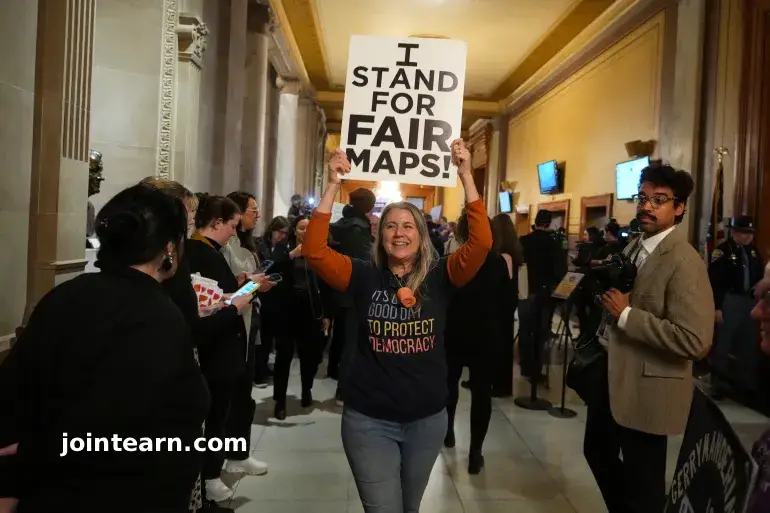
In a major political setback for former President Donald Trump, the Indiana State Senate voted down a controversial redistricting bill on Thursday, refusing to redraw the state’s congressional map ahead of the 2026 midterm elections. The vote, which passed 31 to 19 against the proposal, highlights divisions within the Republican Party and signals a rare break from the nationwide trend of aggressively partisan redistricting.
Despite a strong Republican majority in the 50-seat Senate—where 39 members are GOP-affiliated—the proposal to overhaul Indiana’s nine congressional districts, widely seen as an effort to favor conservative candidates, failed to gain enough support.
Trump Criticizes Indiana Leadership
Following the vote, President Trump addressed the outcome during an Oval Office event, acknowledging the defeat but emphasizing successes in other Republican-led states. Trump denounced Indiana Senate President Rodric Bray and threatened to back primary challengers against senators who opposed the map, signaling ongoing political friction within the party.
“He’ll probably lose his next primary. I hope he does. I’ll certainly support anybody that wants to go against it,” Trump said, according to reports.
This confrontation underscores broader fractures in the Republican caucus, as some GOP leaders resist efforts to aggressively gerrymander districts despite the party’s historic dominance in Indiana. The state has consistently voted Republican in every presidential election since 1968, except for Barack Obama’s victory in 2008.
Proposed Map and Controversy
The proposed redistricting plan, supported by Indiana Governor Mike Braun, aimed to consolidate Republican control by diluting Democratic voting strength, particularly in urban centers like Indianapolis. Critics argued that the plan was undemocratic and could force voters in certain districts to travel over 200 kilometers (124 miles) to cast ballots in person.
Twelve Republicans in the Indiana House had already broken ranks to oppose the bill, and a similar resistance emerged in the Senate. Some lawmakers, including State Senator Greg Walker, cited constitutional concerns as a reason for their opposition. Walker told the Indiana Capital Chronicle that he could not support a bill requiring legal injunctions to ensure constitutionality.
A Nationwide Redistricting Campaign
The Indiana vote comes amid a broader effort by the Trump administration to influence redistricting across the United States. Earlier in 2025, Texas Republicans adopted a new map favoring conservatives after a Democratic walkout, while similar efforts in Missouri and North Carolina sought to solidify Republican gains.
Trump and his allies have invested heavily in Indiana, with Vice President JD Vance and House Speaker Mike Johnson personally lobbying lawmakers. In a social media post just a day before the Senate vote, Trump emphasized the state’s importance, warning that failure to pass the bill could put Republican control in jeopardy.
“One of my favorite States, Indiana, will be the only State in the Union to turn the Republican Party down!” Trump wrote, in a message that highlighted tensions between national GOP priorities and local lawmakers’ independence.
Political Fallout and Implications
The Senate’s rejection of the bill has significant implications for the 2026 midterm elections. Currently, Indiana sends nine members to the U.S. House, two of whom are Democrats. The failed redistricting effort leaves these seats more competitive and signals that some Republican voters and lawmakers are willing to resist partisan gerrymandering.
Governor Braun publicly condemned the Senate’s decision, calling it a rejection of Trump’s leadership and warning that political consequences would follow for dissenting lawmakers.
Looking Ahead
As the 2026 midterms approach, the Indiana outcome illustrates the challenges national Republican leaders face in enforcing uniform strategies across state legislatures. While Trump continues to advocate for partisan redistricting nationwide, Indiana’s resistance suggests that local considerations and individual lawmaker convictions can disrupt even high-profile political campaigns.
Political analysts will be closely watching how the Republican Party navigates these internal divisions in key battlegrounds like Indiana, as Democrats aim to capitalize on legislative fractures to gain ground in the U.S. House of Representatives.


Leave a Reply