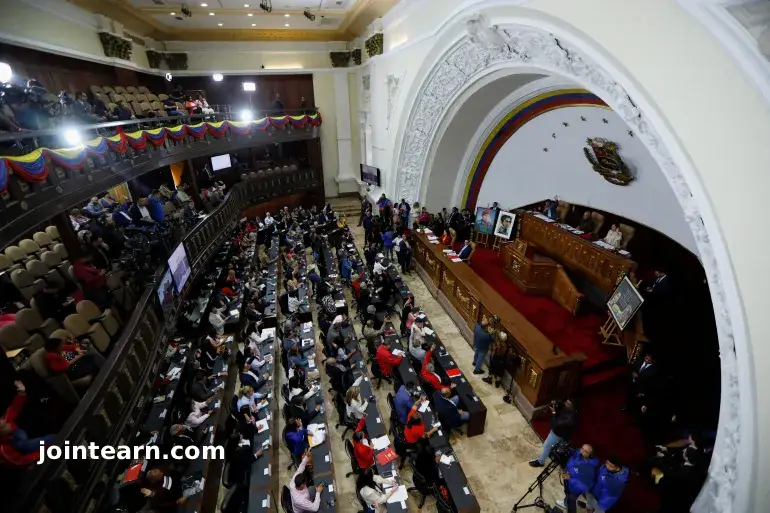
In a dramatic political move, Venezuela’s National Assembly voted on Thursday to begin the process of withdrawing from the Rome Statute, the international treaty that established the International Criminal Court (ICC). The decision comes amid ongoing investigations into alleged human rights abuses by the government of President Nicolas Maduro, highlighting Caracas’s growing defiance of international scrutiny.
National Assembly Calls ICC ‘Useless’
Top lawmakers in Venezuela praised the vote, framing it as a strike against what they described as an outdated and politically biased institution. Jorge Rodriguez, president of the National Assembly and close ally of Maduro, issued a statement declaring the move a demonstration against the court’s “uselessness and subservience.”
Rodriguez accused the ICC of advancing the interests of foreign powers, particularly the United States, which has long refused to recognize Maduro as Venezuela’s legitimate leader. “It only serves the designs of American imperialism,” he said, emphasizing that the ICC’s actions were politically motivated rather than focused on justice.
Despite these claims, the ICC has consistently maintained that its investigation is impartial and focused on allegations of crimes against humanity committed by Venezuelan authorities.
Maduro Expected to Sign Withdrawal
Venezuela initially signed the Rome Statute in October 1998, ratifying it in June 2000. With the National Assembly’s approval, President Maduro is expected to formally sign legislation revoking the country’s ratification, signaling Venezuela’s intention to distance itself from the ICC and assert sovereignty over domestic legal matters.
The vote comes in the context of increasing international pressure. In November 2021, the ICC formally opened an investigation into the Maduro government, citing allegations of extrajudicial killings, torture, sexual violence, and inhumane treatment during anti-government protests, particularly those in 2017. Although the investigation was temporarily paused to allow Venezuela to respond, the court resumed its probe in June 2023, concluding that domestic measures were insufficient to address the allegations.
Ongoing Allegations Against Maduro’s Government
The Maduro administration continues to deny any wrongdoing, asserting that there has been no systematic attack on civilians and no crimes committed by the government. However, multiple human rights organizations have reported extensive abuses, including unlawful imprisonment, violent crackdowns on opposition members, and extrajudicial executions.
Questions have also been raised regarding the independence of Venezuela’s National Assembly, as critics argue that Maduro exerts significant influence over its members, raising doubts about the impartiality of the vote to withdraw from the Rome Statute.
Understanding the Rome Statute and ICC
The Rome Statute, which currently counts 125 member countries, serves as the foundational treaty of the ICC. The court’s mandate includes prosecuting war crimes, genocide, crimes against humanity, and acts of aggression. However, critics have long questioned its effectiveness, noting that major powers such as the United States, China, and Russia are not members.
Over the ICC’s 23-year history, the court has issued 61 arrest warrants, but only 22 individuals have been detained, with several evading prosecution or dying before charges could be executed. So far, the ICC has secured 13 convictions and four acquittals.
Thursday’s vote also followed the ICC’s recent decision to close its Caracas office, established in 2024 to facilitate the ongoing investigation. ICC Prosecutor Mame Mandiaye Niang cited resource constraints and challenges in achieving meaningful progress, prompting a sharp response from Venezuela’s Ministry of Foreign Relations, which accused the ICC of disengagement and political manipulation.
International and Domestic Implications
The withdrawal from the Rome Statute signals Venezuela’s growing isolation from international legal frameworks and heightens concerns about accountability for alleged abuses under Maduro. The ongoing ICC investigation, renewed after the contested 2024 presidential election and subsequent violent government response to protests, continues to draw international attention.
Analysts warn that Venezuela’s move may embolden other nations under investigation to consider similar withdrawals, potentially undermining the global reach of the ICC. Meanwhile, human rights advocates maintain pressure on the international community to monitor developments closely and ensure accountability for serious violations.


Leave a Reply