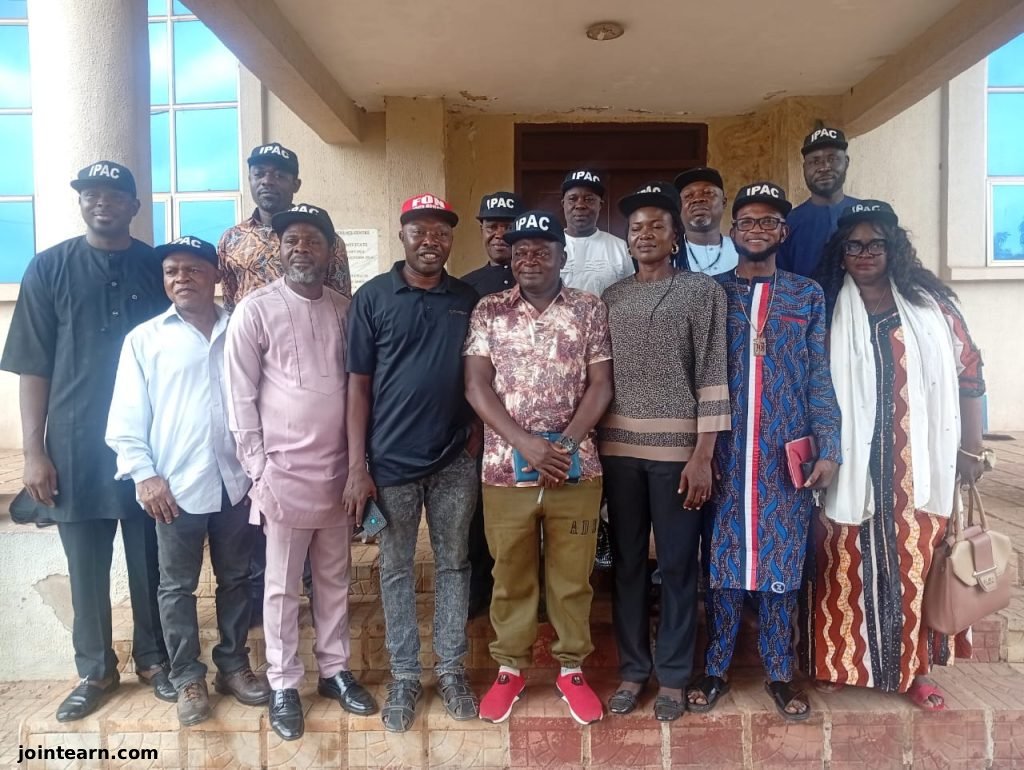
The Inter-Party Advisory Council (IPAC) in Ebonyi State has raised serious concerns over the widespread abandonment of government projects across the state. The council has called on Governor Francis Nwifuru to compel defaulting contractors to resume work or terminate their contracts and recover public funds.
Comrade Nasir Ernest Nwaze, IPAC State Chairman, spoke on behalf of the council during a press briefing in Abakaliki following the body’s annual project inspection tour—a tradition aimed at assessing government performance, advising on areas for improvement, and recognizing notable achievements.
According to Nwaze, IPAC inspected at least six major project sites, including the Industrial City Clusters, Vanco Flyover and Tunnel, ICT University (Oferekpe-Agbaja), Aeronautical University (Onueke), buildings for traditional rulers, and selected housing estates, including the one opposite Chiboy Estate in Abakaliki.
The council expressed particular disappointment at the Industrial City Clusters, noting that “virtually nothing is happening” there. “There were no workers on site. Despite informing the ministry commissioner ahead of our visit, the place was completely deserted,” Nwaze said.
Information gathered by IPAC suggested that contractors often resume work only when inspections or gubernatorial visits are imminent, halting activity immediately afterward.
At Aeronautical University, Onueke, many buildings had not reached the lintel level, signaling apparent abandonment. Nwaze pointed out that most contractors are local stakeholders from Ebonyi State. The only structure nearing completion, reportedly about 80–85% finished, belonged to former House of Representatives member Hon. Lazarus Nweru Ogbee, making it the most advanced at the site.
In contrast, the ICT University in Oferekpe-Agbaja impressed IPAC with active on-site work and satisfactory progress. Similarly, work at the Vanco Flyover and Tunnel was proceeding steadily, in line with the governor’s assurance that the project would be completed next year.
However, the council raised concerns regarding the Ministry of Transport, noting that newly constructed bus stops remain unused. Drivers and commuters reported that the ministry’s task force prevents buses from stopping at designated points, labeling them “resting places” rather than loading zones, which has caused inconvenience for passengers.
IPAC urged local contractors to honor their responsibilities, warning that abandoned projects undermine the governor’s efforts to empower indigenous businesses. “These projects are handled by our local contractors and brothers. Their neglect does not help the governor or Ebonyi State,” Nwaze stated.
The council also criticized commissioners, Senior Special Assistants, and Special Assistants tasked with project monitoring, highlighting lapses in complementing the governor’s initiatives. “The governor cannot assign duties and still come down to do the work himself,” Nwaze added.
IPAC called on Governor Nwifuru to take decisive action, including compelling contractors to resume work, terminating non-performing contracts, and, if necessary, using security agencies to recover misappropriated funds.
Despite these criticisms, the council praised several members of the state executive council for exemplary performance. Commendations went to the State Attorney General and the Commissioner for Agriculture and Natural Resources for running a competitive state hatchery, the Commissioner for Education for eliminating substandard schools, and the Commissioner for Tertiary Education for effectively administering scholarships for students locally and abroad. The Commissioner for Environment was also lauded after Ebonyi was ranked the second-cleanest state in Nigeria.
Nwaze emphasized that IPAC’s support for the governor is non-partisan, grounded in the people’s needs rather than political affiliation. He praised Governor Nwifuru for fostering inclusivity and political peace in Ebonyi, allowing parties like PDP and APGA to operate freely.
He urged the governor to sustain his developmental efforts, describing ongoing projects and reforms as initiatives for the people rather than partisan achievements.


Leave a Reply