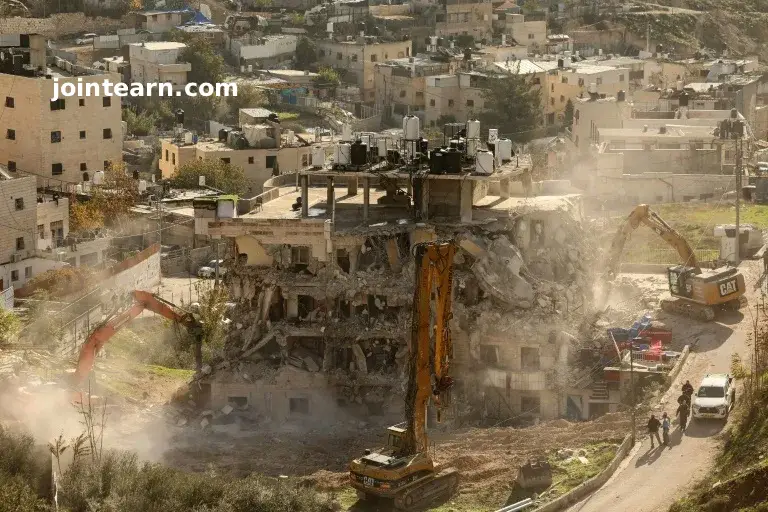
Israeli authorities demolished a four-storey residential building in east Jerusalem on Monday, forcibly evicting dozens of Palestinian families. The operation, carried out in the Silwan neighborhood near the Old City, left around 100 residents—including women, children, and elderly individuals—without homes and uncertain where to go. Eyewitnesses reported that authorities carried out the evictions in the early hours, breaking down doors while residents were asleep.
Details of the Demolition
The building comprised a dozen apartments housing roughly 100 Palestinians. Families were given only moments to collect essential documents and clothing before the bulldozers tore through the structure. Many residents, like Eid Shawar, a father of five, expressed shock and despair. Shawar revealed that his family had nowhere to go and might have to sleep in their car temporarily.
Israeli police blocked surrounding streets, deploying security forces on rooftops and across the area. By midday, the building had largely been razed, leaving residents’ belongings scattered across the streets.
Authorities cited the lack of construction permits as the reason for the demolition. The Jerusalem municipality stated the structure violated a 2014 court order and was built on land zoned for leisure and sports purposes rather than residential use.
Palestinian Concerns: “Systematic Policy of Displacement”
Local Palestinian officials and activists described the demolition as part of a systematic policy aimed at displacing Palestinian residents. Organizations such as Ir Amin and Bimkom reported that roughly 100 families in east Jerusalem lost their homes in 2025 due to similar demolitions.
Obtaining building permits in east Jerusalem is notoriously difficult for Palestinians because of restrictive Israeli planning policies, which activists argue contributes to long-standing tensions in the region. The Jerusalem governorate, affiliated with the Palestinian Authority, condemned the demolition, calling it part of a broader strategy to replace Palestinian residents with Israeli settlers.
Context: Settlement Expansion and Rising Tensions
The demolition occurred shortly after Israel approved 19 new settlements in the occupied West Bank, a move widely regarded as illegal under international law. Silwan, where the demolition took place, sits at the foot of the Old City and is home to nearly 50,000 Palestinians living alongside hundreds of Israeli settlers.
Activists accuse Israeli authorities of designating areas in east Jerusalem as national parks or open spaces to advance settlement expansion. In Silwan, the demolished building had been scheduled for discussion regarding legalizing its construction, but authorities carried out the demolition without prior notice, according to Ir Amin and Bimkom.
Human Impact and International Implications
Residents expressed concern for vulnerable individuals, including children and a cancer patient living in the building. The demolition adds to the ongoing humanitarian strain faced by Palestinians in east Jerusalem and highlights the deepening Israeli-Palestinian conflict.
Jerusalem’s status remains one of the most contentious issues in the Middle East. Israel considers east Jerusalem part of its undivided capital, while Palestinians envision it as the capital of a future state. The United Nations, however, does not recognize Israel’s annexation of east Jerusalem and considers it illegal under international law.
Tensions in east Jerusalem and its Old City have escalated since the October 7, 2023 Hamas attack and the subsequent war in Gaza, with demolitions and settlement expansions further inflaming hostilities.
Looking Ahead
With Israeli authorities continuing to enforce demolitions and approve new settlements, residential insecurity for Palestinians in east Jerusalem remains high. The ongoing disputes over construction permits, land use, and settlements are likely to fuel further tensions in the region. International observers and local activists continue to monitor the situation closely, emphasizing the need for dialogue and legal protections for vulnerable residents.


Leave a Reply