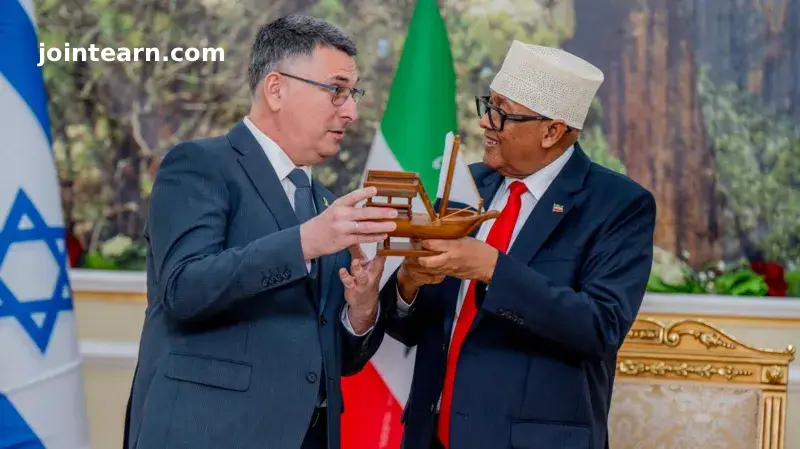
Israel’s foreign minister, Gideon Saar, has completed a historic visit to Somaliland, holding talks with the region’s president, Abdirahman Mohamed Abdullahi, in a landmark step following Israel’s controversial recognition of Somaliland as an independent state. This is the first official visit by an Israeli minister to the breakaway region since recognition was granted last month, a move that has triggered strong reactions from Somalia and the international community.
Historic Visit: Strengthening Israel-Somaliland Relations
During the visit, Saar emphasized Israel’s commitment to advancing relations with Somaliland “with momentum”, highlighting plans for cooperation in agriculture, health, technology, and economic development. President Abdullahi called the visit a “big day” and praised Israel’s decision as “courageous”, signaling an intention to deepen strategic ties.
Saar posted on X (formerly Twitter) that the discussions covered the entirety of bilateral relations, while asserting that Israel’s recognition of Somaliland was not directed against any other country.
“Only Israel will determine for itself who it recognises,” Saar said, defending the diplomatic decision.
Background: Israel Recognizes Somaliland
Somaliland declared independence from Somalia in 1991, following the overthrow of military dictator Siad Barre. While functioning as a de facto independent state with its own government, military, and currency, Somaliland has not been widely recognized internationally—until Israel’s announcement last month.
Israeli Prime Minister Benyamin Netanyahu cited Somaliland’s right to self-determination as the reason for recognition. This unprecedented move prompted an emergency UN Security Council meeting and drew criticism from multiple countries.
- China, Turkey, and the African Union condemned the recognition.
- The European Union reaffirmed Somalia’s territorial sovereignty.
- The United States defended Israel, accusing critics of double standards.
Somaliland hopes Israel’s recognition will inspire other nations to follow suit, though India’s foreign ministry denied recent claims that it would recognize Somaliland.
Strategic and Regional Significance
Experts argue that Israel’s engagement with Somaliland has strategic underpinnings. According to the Institute for National Security Studies in Israel, Somaliland is located in a key position along the Red Sea, which could provide Israel with allies in the region for strategic security purposes, including potential operations against the Houthis in Yemen.
Abdullahi has also expressed interest in joining the Abraham Accords, the peace framework brokered by the Trump administration in 2020 that normalized relations between Israel and several Arab states. Such alignment could strengthen Somaliland’s international legitimacy and open avenues for regional partnerships.
Bilateral Cooperation: Economy, Technology, and Development
During the talks, Israel pledged to assist Somaliland in multiple sectors:
- Agriculture: Improving crop yields, irrigation systems, and food security.
- Health: Enhancing medical infrastructure and healthcare delivery.
- Technology: Providing expertise in cybersecurity, telecommunications, and innovation.
- Economy: Supporting trade, investment, and capacity building.
Analysts note that Israel sees Somaliland as a stable partner in the Horn of Africa, contrasting with Somalia’s ongoing security challenges.
Somalia Condemns Visit
Somalia condemned Saar’s visit as “unacceptable interference” in its internal affairs. The Somali government continues to regard Somaliland as an autonomous region within its borders, rejecting all moves toward recognition of independence.
This diplomatic tension adds another layer to Israel’s foreign policy, as the country navigates complex regional politics while seeking strategic allies near the Red Sea shipping lanes.
International Reactions and Future Outlook
The visit has generated global attention and sparked debate over territorial sovereignty and self-determination. While Israel and Somaliland appear committed to strengthening ties, regional dynamics remain delicate:
- UN and African Union urge dialogue and respect for Somalia’s claims.
- European nations advocate for diplomatic solutions that do not escalate conflict.
- Israel continues to assert its right to independently recognize states, emphasizing pragmatic strategic interests.
Abdullahi confirmed discussions on future visits to Israel, further solidifying a partnership that analysts say could have long-term implications for trade, security, and regional geopolitics.
Conclusion
Israel’s recognition of Somaliland and the historic visit by Gideon Saar marks a significant shift in Horn of Africa geopolitics. The move is likely to deepen Israel-Somaliland cooperation while continuing to generate controversy internationally. As both nations pursue strategic, economic, and technological collaboration, the situation remains a focal point for regional security analysts and international observers.


Leave a Reply