Tokyo, December 23, 2025 – Japan has issued its strongest warning yet on the yen’s rapid depreciation, with Finance Minister Satsuki Katayama signaling that the government is prepared to intervene in the currency market if the yen moves too far from its economic fundamentals.
Speaking at a press conference, Katayama emphasized that recent yen declines “absolutely do not reflect fundamentals” and attributed the weakness to speculative moves. She reiterated that Tokyo has a free hand under its September agreement with the United States to act when excessive volatility threatens economic stability.
Yen Responds to Intervention Risk
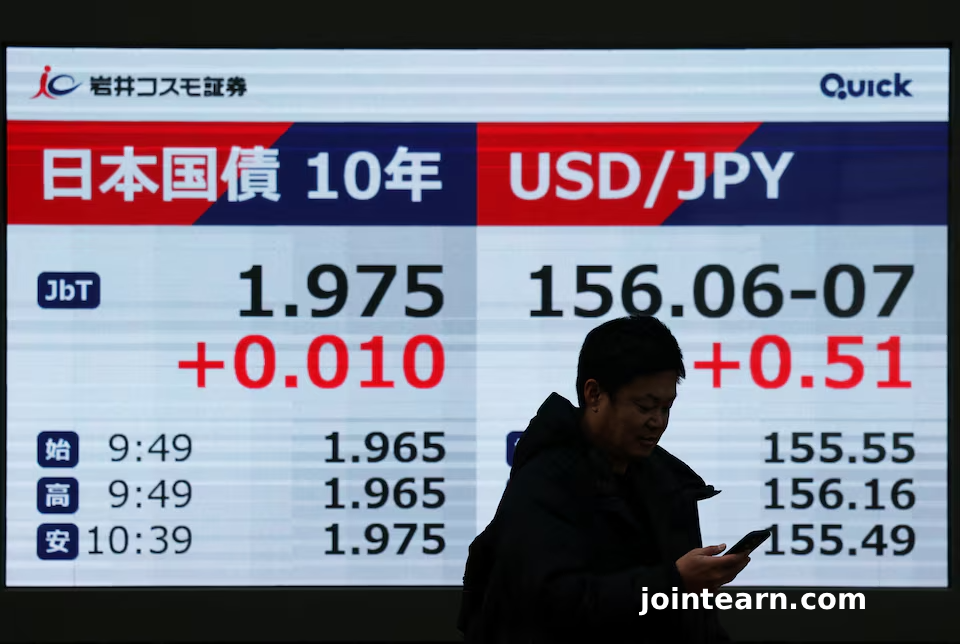
Katayama’s remarks immediately lifted the yen to around 156 per U.S. dollar, a recovery from the 11-month low of 157.78 reached last Friday. Analysts say that if the dollar climbs past 158 yen, Tokyo is likely to step into the market again.
“If the dollar climbs past the post-BOJ press conference highs into 158 yen and beyond, the government would conduct intervention at some point for sure,” said Hiroyuki Machida, director of Japan FX and commodities sales at ANZ.
The yen’s weakness has been a growing concern for policymakers because it raises import costs, pushes up inflation, and increases household living expenses.
BOJ Rate Hike Fails to Strengthen Yen
Last Friday, the Bank of Japan (BOJ) raised its policy rate to 0.75%, the highest in 30 years, marking a significant step in unwinding decades of ultra-loose monetary policy. While the move narrowed Japan’s interest rate gap with the U.S., the yen continued to weaken, as markets interpreted Governor Kazuo Ueda’s comments as signaling a cautious approach to further tightening.
According to Machida, the yen’s decline reflects a combination of the government’s reflationary fiscal policies and the BOJ’s still-easy monetary stance. With Prime Minister Sanae Takaichi’s administration planning an expansionary budget for the next fiscal year, the market may need to see more aggressive monetary tightening to halt the yen’s slide.
Background on Japan-U.S. Currency Agreement
In September, Japan and the U.S. reaffirmed their commitment to market-determined exchange rates, agreeing that foreign exchange interventions should be used only to curb excessive volatility. Policymakers in Tokyo have cited this agreement as justification for intervention when the yen strays significantly from its fundamental value.
The last time Japan intervened in the currency market was July 2024, when authorities bought yen after it hit a 38-year low of 161.96 per dollar. Analysts now suggest that further intervention could come soon if current trends persist.
Key Takeaways
- Finance Minister Katayama issued the strongest intervention warning to date.
- The yen rose to 156 per dollar after her comments, signaling market sensitivity to intervention risk.
- Weak yen pressures are linked to higher import costs, inflation, and fiscal expansion.
- The BOJ’s 0.75% rate hike has not reversed the yen’s decline, reflecting a cautious monetary policy outlook.
- Analysts expect that if the dollar climbs past 158 yen, Japan could step in with direct market intervention.


Leave a Reply