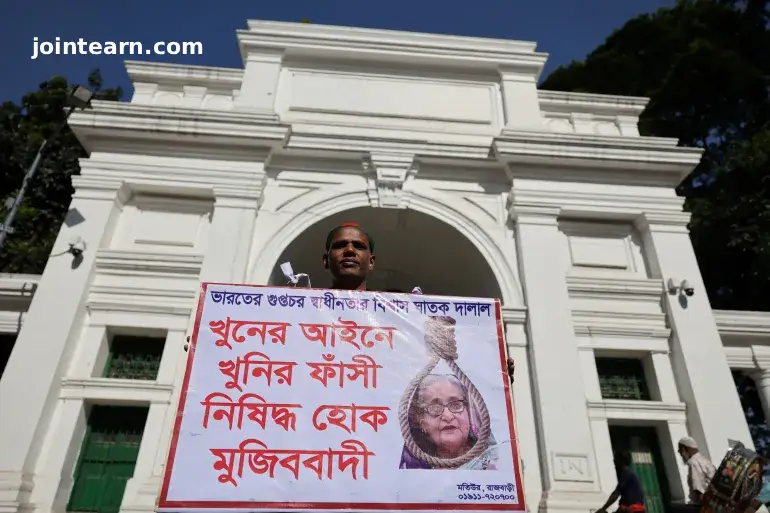
Dhaka, Bangladesh – The streets of Dhaka erupted in emotion on November 17, 2025, as a special court sentenced former Prime Minister Sheikh Hasina and her close aide, former Home Minister Asaduzzaman Khan, to death for crimes against humanity. Families of the victims, many of whom lost loved ones during the student-led July Uprising of 2024, hailed the verdict as a historic moment of accountability.
Shahina Begum, whose 20-year-old son Sajjat Hosen Sojal was shot and burned by police during the crackdown, broke down in tears as the verdict was announced. Her son was killed hours before the uprising forced Hasina to resign after 15 years in power.
Brutal Crackdown on the July Uprising
Prosecutors reported that six student protesters were killed in Ashulia, a hub of the ready-made garments industry on the outskirts of Dhaka. Five were shot and burned, while another was allegedly burned alive inside a police station. The killings, alleged to have been ordered by Hasina, were part of a broader attempt by the ousted government to cling to power.
According to the United Nations, over 1,400 protesters were killed nationwide during the July Uprising, which began as a largely student-led movement against a controversial government quota system favoring children of 1971 war veterans.
Trial in Absentia and Sentencing
The Dhaka International Crimes Tribunal conducted the trial in absentia, as both Hasina and Khan had fled to neighboring India. The court sentenced them to death, while a third accused, former police chief Chowdhury Abdullah al-Mamun, received a five-year jail term for turning state witness.
“My son screamed for help inside that police station. No one saved him,” Begum said. “I will not rest until those who burned him can never harm another mother’s child again.”
Public Reaction and Calls for Extradition
Across Dhaka, hundreds of families gathered to celebrate the verdict while demanding Hasina’s extradition from India to ensure the sentence is carried out. Mir Mahbubur Rahman Snigdho, whose brother was killed during the uprising, urged authorities to bring Hasina back swiftly.
Student protesters, including Ar Rafi of Dhaka University, vowed to remain on the streets until Hasina is returned and executed. Symbolic reenactments of Hasina’s execution were staged by groups such as Maulik Bangla, sending a clear message that “no dictator should rise again,” according to spokesperson Sharif Osman bin Hadi.
Families Call for Full Justice
Victims’ families across Bangladesh emphasized that the death sentence is only meaningful if enforced. Mokbul Hossain, father of student leader Abu Sayeed—the first casualty of the uprising—insisted: “She must be brought back from India and executed in Bangladesh without delay.”
Similarly, Sanjida Khan Dipti, mother of 10th-grade student Shahriar Khan Anas, who was killed in Dhaka, described the verdict as “only a consolation” until justice is physically served. She criticized the light sentence given to former police chief al-Mamun.
Political and International Reactions
Political parties including the Bangladesh Nationalist Party (BNP) and Bangladesh Jamaat-e-Islami praised the ruling as a testament to the rule of law. BNP leader Salahuddin Ahmed stated that it proves “no matter how powerful a fascist or autocrat becomes, they will one day have to stand in the dock.”
However, international human rights organizations expressed concerns. The UN Human Rights Office and Amnesty International cautioned that trials held in absentia with a death sentence may not meet fair trial standards. Amnesty called the death penalty “the ultimate cruel, degrading and inhuman punishment” and stressed the need for proper justice.
Symbol of Resilience
Despite concerns, the verdict has provided some closure to victims’ families. Atikul Gazi, a 21-year-old survivor who lost an arm during the uprising, told Al Jazeera that the sentence offers a sense of justice. “It feels like the souls of the July martyrs will now find some peace,” he said.
For many, the Dhaka tribunal’s verdict is a historic moment, signaling that even the most powerful leaders can be held accountable for atrocities committed during political crises. Yet questions remain about Hasina’s extradition from India and the feasibility of enforcing the sentence.


Leave a Reply