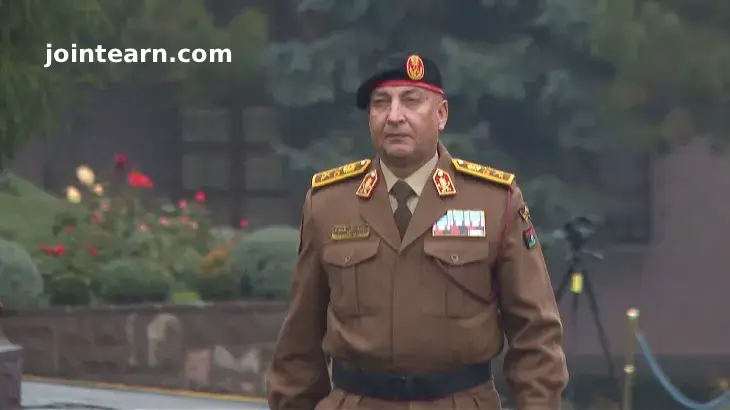
Libya is mourning a major national tragedy after the death of its top military official, Army Chief Mohammed Ali Ahmed al-Haddad, in a plane crash near Turkiye’s capital, Ankara. The accident also claimed the lives of four senior Libyan military officers and three crew members. In response, the United Nations-recognized Government of National Unity (GNU) in Tripoli has declared three days of national mourning.
Details of the Plane Crash
The Dassault Falcon 50-type private jet carrying al-Haddad took off from Esenboga Airport in Ankara on Tuesday evening but disappeared from radar about 40 minutes later. Turkish authorities reported that the plane had requested an emergency landing due to an electrical fault, but communication was lost while it was descending.
Security camera footage aired locally showed a sudden explosion over Haymana district, where the wreckage was later found. Initial investigations by Turkish authorities have ruled out sabotage and indicated a technical failure as the likely cause. The black box has been recovered, and further analysis is ongoing.
Victims of the Crash
In addition to al-Haddad, the crash killed four high-ranking Libyan officers:
- General Al-Fitouri Gharibil, head of Libya’s ground forces
- Brigadier General Mahmoud Al-Qatawi, leader of the Military Manufacturing Authority
- Muhammad Al-Asawi Diab, adviser to the chief of staff
- Muhammad Omar Ahmed Mahjoub, military photographer
The three crew members aboard also lost their lives in the accident.
Al-Haddad’s Role in Libya
Mohammed Ali Ahmed al-Haddad had served as Libya’s army chief of general staff since August 2020, appointed by then-Prime Minister Fayez al-Sarraj. He was widely respected for his dedication to national unity, playing a key role in UN-brokered efforts to reconcile western and eastern factions in Libya, a country divided since the 2014 NATO-backed overthrow of Muammar Gaddafi.
Al-Haddad was particularly noted for his refusal to align with powerful militias that control much of Libya’s territory, striving instead for reconciliation and national cohesion. His death is seen as a significant blow to efforts to unify the country and stabilize its military institutions.
Libya Declares National Mourning
Following the crash, Prime Minister Abdul Hamid Dbeibah expressed grief over the loss of the senior officials. The GNU announced that all state institutions will fly flags at half-mast and suspended official ceremonies and celebrations for three days. Tributes also came from eastern Libya, including rival administration leader Khalifa Haftar, who expressed deep sorrow over the tragedy.
Libya-Turkiye Relations
The Libyan delegation was in Ankara for high-level defense talks aimed at strengthening military cooperation between the two countries. Turkiye has historically supported the UN-recognized government in Tripoli, providing both economic and military assistance, including training personnel and participating in maritime agreements.
The crash occurs amid Turkiye’s evolving “One Libya” policy, which seeks engagement with both western and eastern factions to promote national stability.
Investigation Underway
Turkish authorities, including the Interior and Justice Ministries, are conducting a thorough investigation. The Ankara chief prosecutor’s office has opened a formal inquiry, and the GNU plans to send a team to Ankara to cooperate with Turkish investigators.
While initial reports suggest technical failure, full analysis of the black box and other evidence will determine the exact cause of the crash.
Legacy of Mohammed Ali Ahmed al-Haddad
Al-Haddad is remembered as a unifying figure respected across Libya, known for his discipline, professionalism, and commitment to national service. His death leaves a significant gap in Libya’s military leadership at a time when the country is striving for stability and reconciliation after years of civil conflict.


Leave a Reply