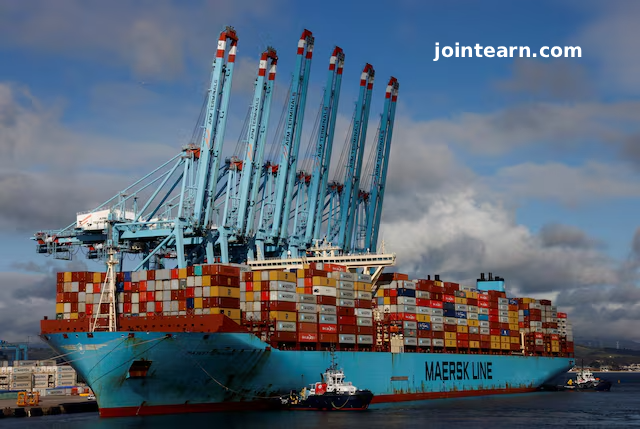
Danish shipping giant Maersk announced on Friday that one of its vessels successfully navigated the Red Sea and Bab el-Mandeb Strait for the first time in nearly two years. The milestone marks a cautious step toward potentially reopening a critical maritime route, although the company currently has no plans for a full resumption.
Background: Route Diversions Due to Security Concerns
Since January 2024, Maersk has been diverting its vessels around the Cape of Good Hope, avoiding the Gulf of Aden and Red Sea, following attacks on ships by Yemen’s Houthi militants. These attacks, conducted in solidarity with Palestinians in Gaza, prompted global shipping firms to take precautionary measures to ensure crew safety and cargo security.
The diversion around the Cape of Good Hope has added significant travel time and operational costs for Maersk’s East-West shipping network, making the Red Sea a strategically important route for future consideration.
Milestone Voyage: Maersk Sebarok
Maersk confirmed that the Maersk Sebarok successfully transited the Red Sea and Bab el-Mandeb Strait on Thursday and Friday. While the company hailed this as a “significant step forward,” it emphasized that the event does not signal an immediate return to a full East-West network through the trans-Suez corridor.
Instead, Maersk is exploring a stepwise approach to gradually resume passage, balancing safety, operational efficiency, and geopolitical risk. At present, no additional sailings through the Red Sea have been scheduled.
Strategic Implications for Global Shipping
The Red Sea and Suez Canal remain crucial for global trade, linking Asia, Europe, and Africa. Maersk’s cautious transit indicates confidence in risk mitigation measures while highlighting the challenges shipping companies face in politically volatile regions.
Analysts say that resuming Red Sea operations, even partially, could reduce transit times and shipping costs for East-West cargo. However, ongoing regional instability, including potential Houthi attacks and geopolitical tensions, continues to influence Maersk’s operational decisions.
Conclusion
Maersk’s successful voyage through the Red Sea after nearly two years underscores both the strategic importance of the route and the company’s cautious, stepwise approach to resuming operations. While full reopening of the trans-Suez corridor remains uncertain, this milestone demonstrates that shipping firms are actively exploring safe methods to restore more efficient trade lanes between Asia and Europe.


Leave a Reply