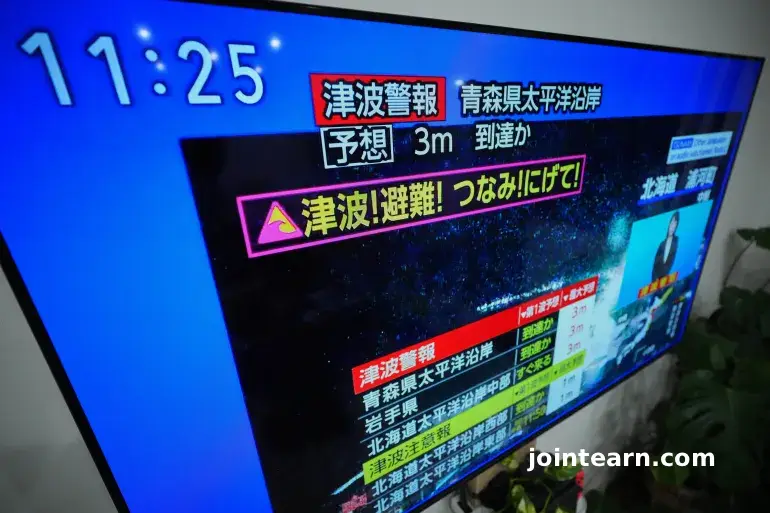
A powerful 7.5-magnitude earthquake shook northeastern Japan late on Monday, leaving at least 23 people injured and prompting tsunami warnings along parts of the coast. The Japan Meteorological Agency (JMA) initially warned of waves as high as 3 meters (10 feet), though the warnings were later downgraded to advisories.
Earthquake Details
The epicenter of the quake was located 80 km (50 miles) off the coast of Aomori Prefecture, at a depth of 50 km (30 miles), according to the JMA. The tremor struck at 11:15 p.m. local time (14:15 GMT) and was felt across multiple prefectures, including Hokkaido, Aomori, and Iwate.
Following the quake, the JMA reported tsunamis ranging from 20 to 70 cm (7 to 27 inches) at several ports, though later assessments suggested lower wave heights, leading to the downgrade of warnings to advisories.
Injuries and Damage
The Fire and Disaster Management Agency confirmed that 23 people were injured, with one person seriously hurt. Most injuries resulted from falling objects. Reports included:
- Several injuries at a hotel in Hachinohe
- A man slightly injured when his car fell into a hole in Tohoku
Infrastructure impacts included:
- Approximately 800 homes without electricity
- Around 480 residents taking shelter at the Hachinohe airbase
- Train service suspensions by East Japan Railway in affected areas
- 200 passengers stranded overnight at New Chitose Airport in Hokkaido
Government and Emergency Response
Prime Minister Sanae Takaichi urged residents in tsunami-affected areas to evacuate immediately to high ground or designated shelters, while Chief Cabinet Secretary Minoru Kihara advised people to remain in safe locations until advisories were lifted.
Minister of Defence Shinjiro Koizumi confirmed that 18 defense helicopters were deployed for damage assessment and rescue operations.
The International Atomic Energy Agency (IAEA) reported no abnormalities at the Fukushima nuclear power plant, and local nuclear facilities conducted safety checks with no immediate issues detected.
Tsunami Threat and Regional Impact
The Pacific Tsunami Warning Center indicated that hazardous tsunami waves could affect areas within 1,000 km (620 miles) of the epicenter, including parts of Japan and Russia. Residents were urged to remain vigilant as emergency services monitored the situation.
Japan’s Seismic Risk
Japan is located in the Ring of Fire, one of the most seismically active regions in the world. The country experiences about 20% of global earthquakes with magnitudes of 6.0 or higher. Notably, Japan was hit by a devastating 9.0-magnitude earthquake and tsunami in March 2011, which caused widespread destruction and loss of life.
This latest earthquake highlights the ongoing earthquake and tsunami risks in northeastern Japan, reinforcing the importance of emergency preparedness and disaster response infrastructure.


Leave a Reply