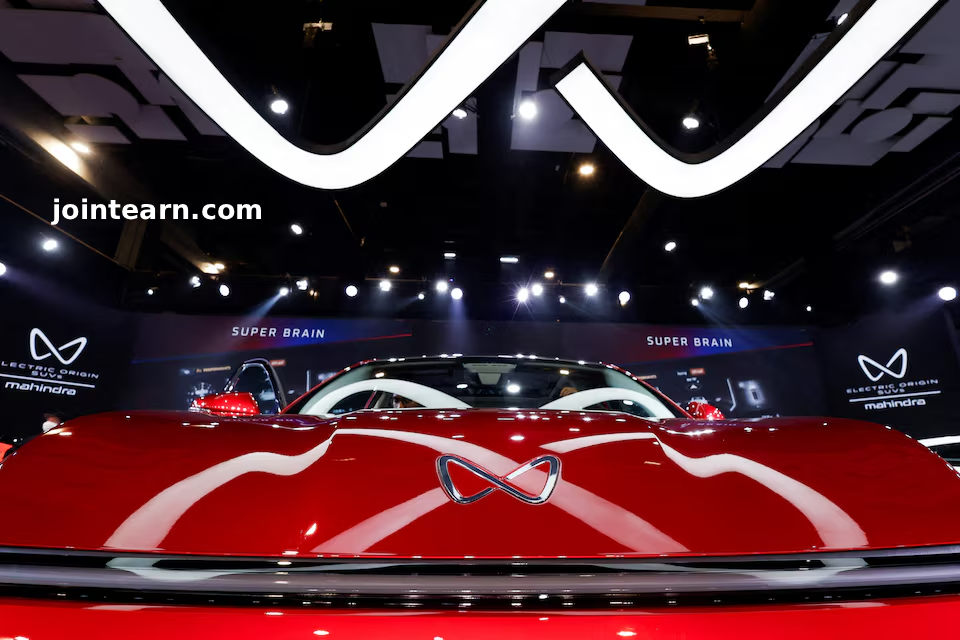
BENGALURU, November 27, 2025 – India’s leading automaker Mahindra & Mahindra has taken a major step in the country’s electric vehicle (EV) revolution by launching a new seven-seater electric SUV, the XEV 9S, with a starting price of approximately 2 million rupees ($22,409). This launch signals Mahindra’s aggressive push into a market segment currently dominated by Tata Motors Passenger Vehicles.
The move comes as India accelerates its transition to electric mobility, with sales of battery-powered vehicles rising sharply to over 100,000 units in 2025, compared with just 23,000 units last year, according to government data.
Mahindra’s Investment and EV Strategy
Mahindra plans to invest an additional 20 billion rupees in the new XEV 9S and a revamped BE6 model, as part of a larger 160 billion-rupee investment program to develop its next-generation Electric Origin SUVs through the fiscal year 2027. These models are designed from the ground up as electric vehicles, rather than adaptations of petrol or diesel models, highlighting Mahindra’s commitment to a fully electric future.
Nalinikanth Gollagunta, CEO of Mahindra’s automotive division, emphasized:
“With the XEV 9S, we are not just participating in the EV segment—we are expanding it.”
The automaker has introduced six variants of the XEV 9S, with the top-of-the-line model priced at around $33,000 and boasting an impressive driving range of 500 km (311 miles). Bookings open on January 14, 2026, with deliveries expected to start on January 23, 2026.
Market Potential and Consumer Impact
Analysts predict that the XEV 9S could capture an additional 5,000–10,000 units annually, addressing a growing demand for seven-seater electric SUVs in India, according to Rishi Vora, Vice President at Kotak Securities.
Mahindra, which ranks as India’s second-largest SUV manufacturer, aims for EVs to constitute at least 20% of its SUV sales by 2027. The company sold over 30,000 electric SUVs between March and October 2025, and production of previous EV models such as the XEV 9E and BE6 currently averages 4,000–5,000 units per month. Mahindra plans to double EV production capacity starting April 2026 to meet growing demand.
EV adoption is also attracting new buyers: analysts note that 80% of Mahindra’s EV customers are new to the brand, reflecting the expanding appeal of electric mobility in India.
Competition in India’s Electric Vehicle Market
Tata Motors, India’s EV market leader, currently offers six electric models, including the Tiago EV (starting at $8,950) and the Harrier SUV EV (starting at $24,000). Hyundai Motor India also competes in the segment with electric variants of its Creta and IONIQ models.
Despite rapid growth, electric four-wheelers account for only 2–3% of total vehicle sales in India, constrained by high upfront costs and uneven charging infrastructure. The Indian government has set an ambitious goal of 30% EV penetration by 2030, signaling strong policy support for the sector.
What This Means for India’s EV Ecosystem
The launch of the XEV 9S is expected to boost consumer choice, stimulate EV adoption in the mid-size SUV segment, and intensify competition among leading automakers. By expanding production and offering a seven-seater electric SUV at a competitive price point, Mahindra is positioning itself as a key player in India’s transition to electric mobility.


Leave a Reply