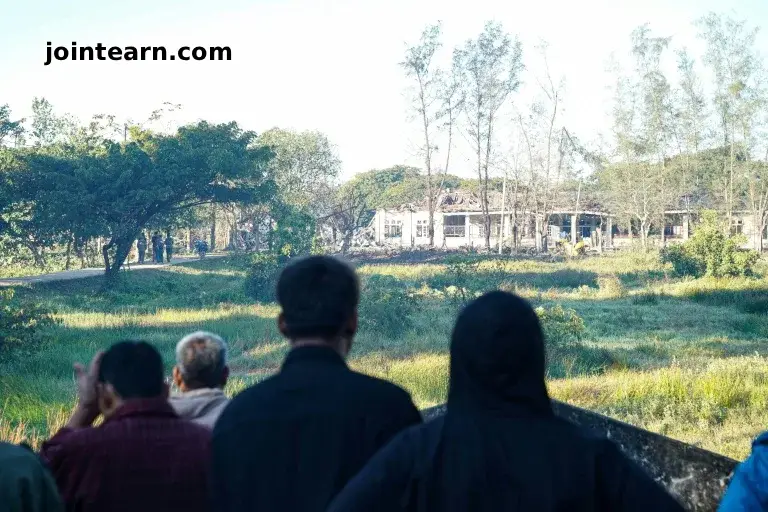
At least 31 people were killed and roughly 68 others injured after a Myanmar military air strike hit Mrauk-U General Hospital in western Rakhine state, near the Bangladesh border, according to local aid workers and witnesses. The attack comes as Myanmar’s military government intensifies its offensive ahead of elections scheduled for December 28, 2025, and amid escalating conflict between the junta and ethnic armed groups.
Aid worker Wai Hun Aung, who arrived at the scene Thursday morning, described the devastation:
“The situation is very terrible. As for now, we can confirm there are 31 deaths and we think there will be more. Also there are 68 wounded and will be more and more.”
Witness Accounts and Casualties
By daybreak, the hospital lay in ruins, with an entire wing destroyed, rubble covering ward beds, and at least 20 shrouded bodies visible outside. Large craters and damaged trees demonstrated the strike’s destructive force.
Local resident Maung Bu Chay, 61, reported losing three family members—including his wife and daughter-in-law—during the bombing. He said:
“I heard the explosion from my village. I spent the entire night not knowing where the bombs had landed. I have nothing to say. I feel resentful about their act. I feel strong anger and defiance in my heart.”
The Arakan Army (AA), an ethnic minority separatist force, confirmed that at least 10 hospital patients were killed instantly during the strike.
Context: Myanmar Civil War
Rakhine state is largely under the control of the Arakan Army, one of Myanmar’s most powerful ethnic armed groups. The AA has resisted the junta’s rule and played a central role in the Three Brotherhood Alliance, alongside other rebel factions. Two other groups recently accepted Chinese-brokered truces, leaving the AA as the dominant force in the region.
The military coup of 2021, which ousted Aung San Suu Kyi’s civilian government, triggered a nationwide uprising. Rebels, ethnic armed groups, and pro-democracy fighters have since fought the junta across multiple fronts, with the military increasingly relying on air strikes and conscripted troops to regain control.
Escalating Air Strikes
The Myanmar junta has escalated air attacks year-on-year, with the goal of suppressing resistance ahead of the upcoming polls. Despite these strikes, the AA controls all but three of Rakhine’s 17 townships, according to conflict monitors.
The military claims the elections will restore stability, but both international observers and local ethnic groups view them as largely illegitimate. Beijing has expressed support for the elections, framing them as a step toward restoring order, though the vote is unlikely to change the power balance in Rakhine state.
Humanitarian Crisis
The ongoing blockade of Rakhine by the military has worsened the humanitarian situation, contributing to rising hunger and malnutrition, according to the World Food Programme. Hospitals, schools, and other civilian infrastructure have been heavily affected, leaving residents vulnerable to injury, displacement, and lack of medical care.
The AA, while controlling most of Rakhine, has also faced accusations of committing atrocities against the Muslim Rohingya minority, further complicating the region’s humanitarian and security landscape.
Implications
The air strike on Mrauk-U General Hospital is one of the deadliest targeting civilian infrastructure in Myanmar’s ongoing civil war. The incident highlights the junta’s reliance on air power to suppress ethnic armed groups and the severe humanitarian consequences for civilians caught in conflict zones.
International human rights organizations continue to condemn attacks on hospitals as violations of international humanitarian law, emphasizing the urgent need for humanitarian aid and protection for civilians in rebel-controlled regions.


Leave a Reply