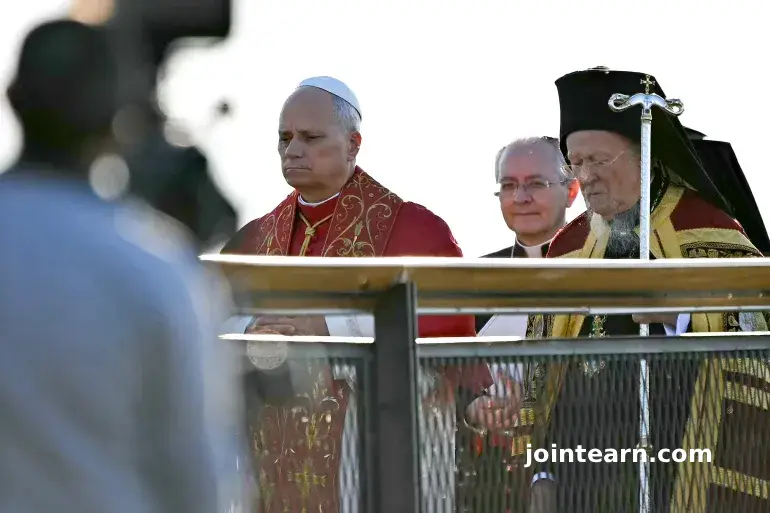
Pope Leo XIV made history during his first overseas trip as the leader of the Catholic Church by visiting Turkiye, a predominantly Muslim country with deep historical ties to Christianity. The American pontiff joined Patriarch Bartholomew I of Constantinople for a landmark ecumenical prayer service, marking the 1,700th anniversary of the First Council of Nicaea, a foundational event in Christian history.
The meeting underscores Pope Leo’s commitment to bridge-building and interfaith dialogue, as he called for unity among Christians and strongly condemned violence and wars waged in the name of religion.
A Historic First Overseas Trip
Pope Leo XIV chose Turkiye as his inaugural international visit, a country “inextricably linked to the origins of Christianity,” according to Vatican officials. His itinerary will soon take him to Lebanon, continuing his mission to promote peace in conflict-ridden regions of the Middle East.
Addressing a gathering of Christian leaders from across the Middle East, Pope Leo emphasized the urgent need for reconciliation in a world afflicted by violence, wars, and religious extremism. “We must strongly reject the use of religion for justifying war, violence, or any form of fundamentalism or fanaticism,” he said. “The paths to follow are those of fraternal encounter, dialogue, and cooperation.”
Ecumenical Prayer at Iznik
The pope’s visit reached a symbolic peak in Iznik, historically known as Nicaea, where early church leaders formulated the Nicene Creed, a statement of faith still central to Christian doctrine.
Pope Leo and Patriarch Bartholomew led prayers in English, Greek, and Arabic, lighting candles near the ruins of a fourth-century basilica submerged under water. This ecumenical ceremony reflects the shared values of the Catholic and Orthodox churches, despite centuries of division.
Al Jazeera’s correspondent reported that the visit was also intended as a message of Christian unity and interfaith dialogue, highlighting the importance of reconciliation in regions affected by ongoing conflicts.
Support for Migrants and Refugees
During his visit, Pope Leo addressed the small yet resilient Catholic community in Turkiye, emphasizing their vital role in assisting the vulnerable. He urged local churches to focus on helping the nearly three million migrants and refugees residing in the country, the majority of whom are Syrians displaced by war.
“The logic of littleness is the church’s true strength,” he told parishioners at Istanbul’s Cathedral of the Holy Spirit, encouraging them to embrace humility and service in their mission.
Security and Pilgrimage
The pope’s journey was tightly secured by Turkish authorities, with main roads in Istanbul closed to accommodate his entourage. Thousands of pilgrims packed the cathedral and surrounding courtyards, eager to catch a glimpse of the pontiff, demonstrating the strong devotion of local Catholics and international visitors alike.
Notably, Turkish police also barred Mehmet Ali Agca, the man who attempted to assassinate Pope John Paul II in 1981, from attending the Iznik event.
Pope Leo XIV: Continuing a Legacy
Pope Leo XIV is the fifth pontiff to visit Turkiye, following Paul VI (1967), John Paul II (1979), Benedict XVI (2006), and Francis (2014). His visit continues a tradition of fostering dialogue between the Catholic and Orthodox churches while emphasizing the Church’s commitment to serving marginalized communities.
By commemorating the First Council of Nicaea, the pope highlights the enduring significance of Christianity’s early councils and the ongoing need for ecumenical cooperation, particularly in regions where Christians are a minority.


Leave a Reply