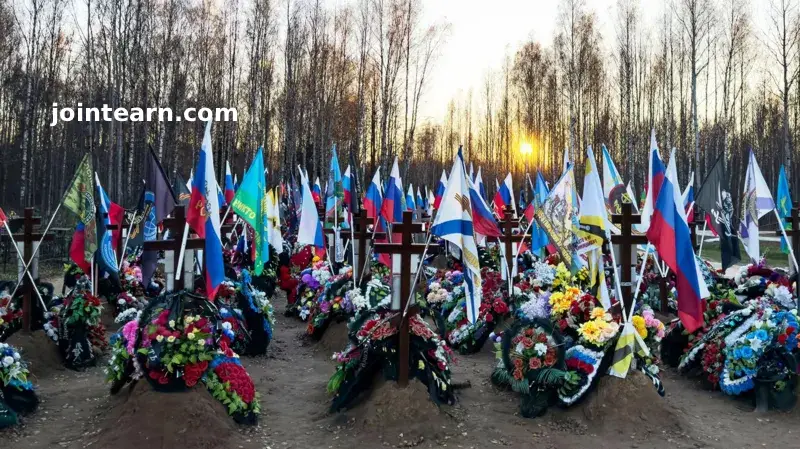
Over the past ten months, Russia’s losses in the ongoing war with Ukraine have escalated faster than at any other time since the full-scale invasion began in February 2022. Analysis by BBC News Russian, conducted alongside independent outlet Mediazona and a team of volunteers, suggests that the death toll on Russia’s side is now unprecedented in its growth, raising serious questions about the human cost of the conflict and the Kremlin’s military strategy.
The spike in Russian casualties comes as the United States, under the administration of President Donald Trump, has actively pushed for a comprehensive peace deal with Moscow. Since early 2025, the number of published obituaries for Russian soldiers has increased by 40% compared with the previous year, reflecting both the intensifying fighting on the frontlines and the continued reliance on volunteers and conscripts.
Confirmed Deaths and the Real Toll
The BBC has confirmed the names of nearly 160,000 Russian soldiers killed in Ukraine, using official reports, newspapers, social media, and new memorials and graves. Experts suggest that this figure represents only 45–65% of the actual total. Applying these estimates, Russia’s true military losses could range between 243,000 and 352,000 soldiers.
While obituaries offer a preliminary view of confirmed casualties, they also serve as a metric to track the intensity of combat over time. For instance, 2025 began with a lower number of reported deaths in January, but this surged in February following direct discussions between Donald Trump and Vladimir Putin about ending the war.
A further peak occurred in August, coinciding with the high-profile Alaska meeting between the two leaders—a diplomatic success for Putin, seen internationally as a partial lifting of his isolation. In October and November, after the US unveiled a 28-point peace proposal, Russia saw an average of 322 obituaries per day, doubling the daily figures recorded in 2024.
Why Russian Losses Are Rising
Pinpointing the exact reasons behind the surge in Russian military losses is complex. Analysts suggest that the Kremlin has leveraged territorial gains as bargaining chips in negotiations with the United States. Putin aide Yuri Ushakov has explicitly stated that “recent successes” on the battlefield positively influence Moscow’s diplomatic leverage.
At the same time, the profile of Russian casualties is changing. Many of those who die on the frontlines today were not professional soldiers at the start of the war but volunteers or late recruits. Since the brutal battle for Avdiivka in October 2023, volunteers—those who signed up after the war began—now constitute the majority of new recruits. In 2024, volunteers accounted for just 15% of Russian military deaths; in 2025, that figure has risen to one in three.
Case Study: Murat Mukashev
One tragic illustration of Russia’s new volunteer wave is Murat Mukashev. Mukashev, an activist who had openly opposed Putin’s policies and protested against police violence and the war in Ukraine, was sentenced to 10 years in a high-security penal colony for drug-related charges in early 2024.
Under a 2024 law, prisoners facing criminal charges could avoid long sentences by joining the military. Initially, Mukashev refused the offer, remaining committed to his political beliefs. However, after hearing promises from Trump that the war could end swiftly, he signed up while in prison, hoping to secure his release before any peace deal took effect.
Tragically, on June 11, 2025, Mukashev was killed during combat in Ukraine’s Kharkiv region as part of an assault squad. His story reflects the harsh reality that many new recruits are caught between legal pressure, political uncertainty, and the brutal realities of war.
Recruitment Tactics and Volunteer Surge
The Russian government has actively promoted military recruitment to maintain troop levels amid heavy casualties. Local authorities offer financial incentives, debt relief, and targeted campaigns in universities and colleges, drawing in individuals who might not otherwise join.
By October 2025, 336,000 people had voluntarily enlisted, averaging over 30,000 recruits per month, according to Dmitry Medvedev, deputy chief of Russia’s National Security Council. NATO officials, including Secretary-General Mark Rutte, estimate that Russia is losing 25,000 soldiers per month, yet recruitment levels suggest Moscow is still replacing losses more rapidly than they occur.
New recruits can reportedly earn up to 10 million roubles (£95,000; $128,000) annually, though contracts signed since September 2022 automatically renew until the war ends, contrary to some recruits’ expectations.
Total Casualties and Broader Context
NATO estimates place the combined number of Russian dead and wounded in the conflict at 1.1 million, with fatalities around 250,000—a figure consistent with BBC analysis. These numbers do not account for fighters in militias in two occupied regions of eastern Ukraine, estimated at 21,000–23,500 deaths.
Ukraine has also suffered heavily. President Volodymyr Zelensky reported 46,000 battlefield deaths and 380,000 injuries by February 2025, with tens of thousands more missing or held captive. Independent estimates suggest Ukraine’s total fatalities could now exceed 140,000.
Conclusion
The ongoing war in Ukraine continues to exact a severe toll on both Russian and Ukrainian forces. Russia’s reliance on volunteers and incentivized recruits highlights the human cost of sustained conflict, even amid diplomatic efforts led by the United States. With peace talks ongoing, the coming months may be pivotal in determining both the trajectory of the war and the lives of thousands still on the frontlines.


Leave a Reply