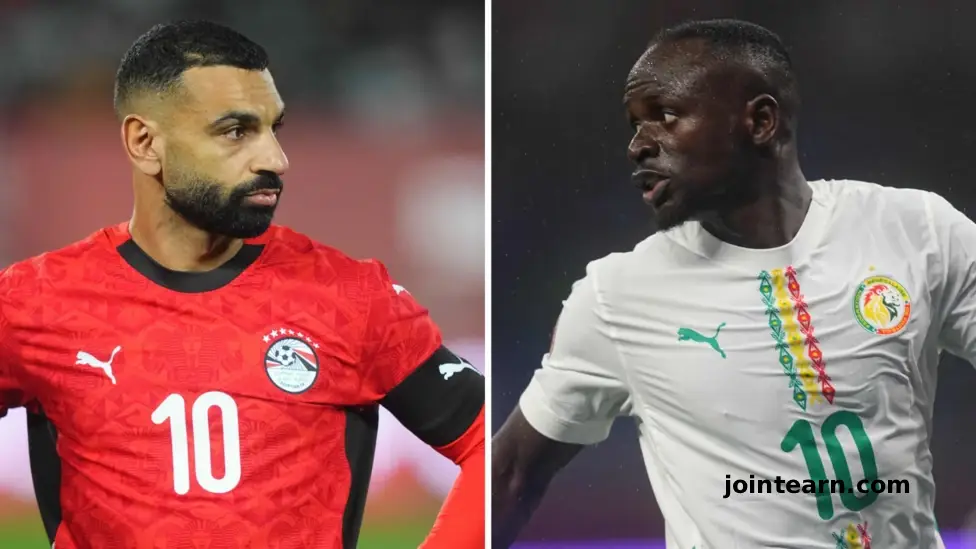
When Mohamed Salah leads Egypt onto the pitch for their Africa Cup of Nations (AFCON) 2025 semi-final against Senegal, it will be more than just a battle for a place in the final. It will mark the latest chapter in one of African football’s most compelling rivalries: Salah vs Sadio Mane.
Once inseparable teammates at Liverpool, where they helped deliver Champions League and Premier League glory, the two superstars now stand on opposite sides again—this time with national pride, legacy, and history on the line in Tangier.
For Salah, the match represents opportunity, pressure, and possibly his last realistic chance to win AFCON. For Mane, it is another step toward reinforcing his status as one of Senegal’s greatest-ever players.
Salah’s Unfinished Business With AFCON
Egypt are seven-time African champions, the most successful nation in the tournament’s history, but their last title came in 2010, before Salah had even made his international debut.
Now 33 years old, the Pharaohs captain has endured repeated heartbreak at the continental stage:
- Runner-up in 2017
- Runner-up again in 2021, losing on penalties to Senegal
- Last-16 exit in 2019 on home soil
- Early exit in 2023, after Salah suffered an injury
The weight of those disappointments is clear.
“Nobody, even in Egypt, wants to win this trophy more than me,” Salah said after scoring the winner against Ivory Coast in the quarter-finals.
“I have won almost every prize. This is the title I am waiting for.”
With AFCON set to become a quadrennial tournament from 2028, this edition may be Salah’s final opportunity to lift the trophy and cement his legacy not just as a global star—but as an African great.
Across the continent, there remains a widely held belief: true greatness in African football is only confirmed with an AFCON title.
Mane Has Had the Upper Hand on the International Stage
While Salah has dominated club football statistics, Sadio Mane has often emerged victorious when national teams collide.
Their most famous international showdown came in the AFCON 2021 final in Cameroon. The match, billed globally as a duel between Liverpool teammates, ended goalless after extra time.
Mane missed an early penalty, but Senegal ultimately triumphed in the shootout. The forward stepped up to score the decisive kick—while Salah, waiting to take Egypt’s fifth penalty, never got the chance.
That night in Yaounde delivered Senegal’s first-ever AFCON title.
“The best day of my life and the best trophy of my life,” Mane said afterward.
Just weeks later, history repeated itself in the 2022 FIFA World Cup qualifiers. Egypt and Senegal again went to penalties after two tight legs. This time, Salah missed his spot kick, while Mane once more converted the winner, sending Senegal to Qatar.
Of their last three international meetings, Mane has emerged on top twice, a psychological edge that lingers ahead of this semi-final.
Salah Leading Egypt’s Charge in Morocco
Despite arriving at AFCON 2025 under a cloud of uncertainty at club level, Salah has rediscovered his best form in Morocco.
After publicly stating he felt “thrown under the bus” by Liverpool and hinting at a breakdown in relations with manager Arne Slot, Salah endured a brief spell out of the side and intense speculation about his future.
AFCON, however, has provided a reset.
Salah has scored four goals in four matches, equalling his total from 14 Premier League appearances this season. His goals have been decisive:
- Match-winners against Zimbabwe and South Africa
- A late extra-time strike against Benin in the last 16
- The winning goal against Ivory Coast in the quarter-finals
He now has 11 AFCON goals, level with Egypt coach Hossam Hassan and just one behind national record-holder Hassan El-Shazly.
Egypt’s attacking threat does not rest solely on Salah. Support comes from:
- Omar Marmoush (Manchester City), with two goals
- Trezeguet, Egypt’s top scorer in qualifying
- Mostafa Mohamed, providing physical presence up front
But make no mistake—this is still Salah’s team.
Mane: Senegal’s Inspiration and Leader
For Senegal, Sadio Mane remains the emotional and tactical heartbeat of the team.
The Al Nassr forward has started all five matches, scoring once and providing three assists, while playing a key role in build-up play and chance creation.
BBC Afrique journalist Babacar Faye highlighted Mane’s broader influence:
“Beyond his on-field skills, his leadership is vital. He helps everyone maintain focus and belief.”
Crucially, Senegal are no longer dependent on Mane alone.
They boast attacking depth and variety, including:
- Iliman Ndiaye (Everton)
- Ismaila Sarr (Crystal Palace)
- Nicolas Jackson or Habib Diallo leading the line
There is also excitement around 17-year-old Ibrahim Mbaye, whose explosive cameos have caught the eye. Coach Pape Thiaw has described him as “a gem” for the future.
Experience remains Senegal’s backbone, with survivors from the 2021 triumph including:
- Goalkeeper Edouard Mendy
- Captain Kalidou Koulibaly
- Midfielder Idrissa Gana Gueye
- Mane himself
Liverpool Legacy: Success, Tension, and Comparison
Salah and Mane’s rivalry is inseparable from their time at Liverpool, where they formed one of Europe’s most feared attacking trios alongside Roberto Firmino.
Together, they helped end a 30-year wait for a league title and lifted the Champions League, but tensions were occasionally visible.
Salah outscored Mane 118 to 77 in the Premier League during their shared time at Anfield, but Mane later hinted at frustrations.
“Sometimes he would pass to me and sometimes he wouldn’t,” Mane said.
“Only Bobby was there to share the balls.”
Mane left Liverpool in 2022, later moving to Saudi Arabia. Salah, meanwhile, remains heavily linked with the Saudi Pro League, with Liverpool having rejected a £150m bid in 2023.
Legacy on the Line in Tangier
As Egypt and Senegal prepare for their AFCON semi-final, the spotlight once again falls on two icons whose careers have been intertwined for over a decade.
For Mane, this is about defending Senegal’s crown and strengthening an already historic legacy.
For Salah, it may be his final shot at the one trophy that continues to elude him.
At the Grand Stade de Tanger, friendship will give way to rivalry—and only one will take a step closer to African immortality.


Leave a Reply