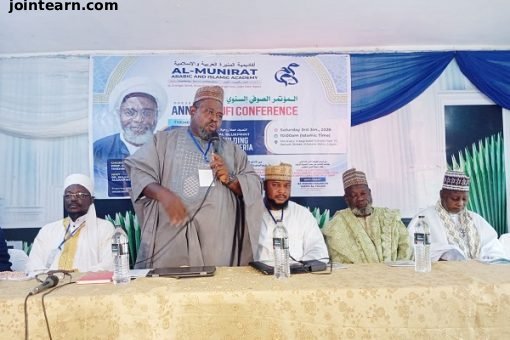
Islamic scholars, clerics and academics have called for the adoption of Sufism as a moral and spiritual strategy to address insecurity and social decline in Nigeria, stressing that lasting peace can only be achieved through the inner reformation of individuals.
The call was made at the maiden Sufi Conference organised by Al-Munirat Arabic and Islamic Academy, themed “Sufism: A Spiritual Blueprint for Peace-Building and Security in Nigeria.”
Convener of the conference, Dr Sulaiman Algamawi, said the gathering was aimed at drawing government attention to non-military solutions to insecurity, arguing that ethical and spiritual renewal is crucial to restoring peace.
“Beyond conventional security measures, there is a moral tool capable of restoring peace in Nigeria, and that is Sufism or Tasawwuf. Through Sufi training and ethics, insecurity can be significantly reduced,” he said.
Algamawi explained that the conference marked the first in a series of intellectual engagements designed to correct misconceptions about Sufism and reposition it as a force for moral transformation and national stability. He added that plans are underway to make the conference an annual national event, with an international outlook in the coming years.
He clarified that Sufism goes beyond rituals such as chanting or Qur’anic recitation, noting that its core lies in ethical discipline and character development rooted in the Qur’an and the Sunnah of Prophet Muhammad (SAW).
“When character is reformed, insecurity can be curbed—starting from individual behaviour and extending to the wider society,” Algamawi said, adding that the academy also organises Ramadan lectures, symposiums and counselling sessions to instil responsibility among students.
Chairman of the occasion, Dr Saheed Timehin, a lecturer in the Department of Foreign Languages at Lagos State University, described Sufism as the inner dimension of Islamic teachings, focused on purification of the soul and ethical conduct.
“Sufi ethics are not different from the Islamic values taught by the Prophet. When properly practised, they transform the soul and help re-orient society,” he said.
Timehin attributed controversies surrounding Sufism to ignorance and urged Sufi scholars to engage more actively with the media and the public. He also recommended that academic papers presented in Arabic be translated into English to broaden public understanding.
Also speaking, Dr Abubakar Salaty, a lecturer in the Department of Arabic and Transnational Studies at the University of Ilorin, emphasised that authentic Sufism is firmly grounded in the Qur’an and the Sunnah.
“The Prophet Muhammad (SAW) was described by the Qur’an as the best of character, and when character decays, society decays,” he said.
Salaty stressed that moral reform must begin at home, urging parents to instil strong values in their children. He highlighted patience, dignity of labour and lawful means of livelihood as core Islamic principles, warning against the pursuit of quick wealth.
“Nothing good comes easy. Islam teaches hard work and entrepreneurship. Moral decay and the desire for fast money are among the roots of our societal problems,” he said.
The event attracted prominent clerics and scholars from across the country, who jointly underscored the need for ethical reorientation as a foundation for peace and security in Nigeria.


Leave a Reply