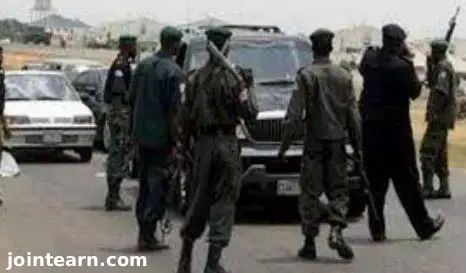
Major roads across Nigeria’s South-East remain dotted with security checkpoints operated by the Police, Army, Road Safety Corps, Customs, and other agencies, with commuters decrying rampant extortion, intimidation, and harassment.
As the Christmas and New Year travel season approaches, road users fear the situation could worsen, with many returnees vulnerable to demands for bribes along the routes.
A survey by Youths and Students Advocates for Development (YSAD) revealed that the Port Harcourt-Aba expressway alone has over 30 checkpoints within just 60 kilometers, manned by multiple law enforcement agencies. YSAD’s CEO, Obinna Nwagbara, condemned the widespread extortion, calling it a major contributor to societal challenges and urging decisive action from the Chief of Army Staff and Inspector-General of Police.
In Imo State, commercial drivers described checkpoints as “toll gates,” with uniformed personnel openly collecting money from vehicles and sometimes detaining those who refuse to pay. Similar complaints emerged from Ebonyi, Enugu, and Anambra states, where motorists report being forced to pay anywhere from ₦100 to ₦1,000 per checkpoint, with some checkpoints strategically placed less than a kilometer apart.
While security agencies justify checkpoints as necessary for combating kidnappings and highway crime, critics argue the system has become a profitable enterprise for personnel, shifting from major roads to township streets. In Onitsha, for example, officers reportedly extort tricycle and commercial vehicle operators even in the city center.
The Igbo Women Assembly (IWA) has called for the withdrawal of the military from road checkpoints, advocating for increased police patrols and modern surveillance methods instead of the analogue system.
Some, like Chief Godwin Ubaka Okeke, Chairman of GUO Group of Companies, contend that checkpoints, despite extortion, are preferable to encounters with armed bandits, arguing that security personnel are more lenient and humane compared to criminals.
Law enforcement officials, including the Imo and Anambra Commissioners of Police, condemned extortion and warned officers that anyone caught engaging in bribery would face severe consequences. Meanwhile, human rights groups advocate for digital surveillance systems such as CCTV cameras to replace traditional checkpoints, emphasizing intelligence-driven policing over roadside harassment.
YSAD and other civil society organizations continue campaigns like “No Dey Give”, pushing for accountability, transparency, and an end to corrupt practices on South-East highways.


Leave a Reply