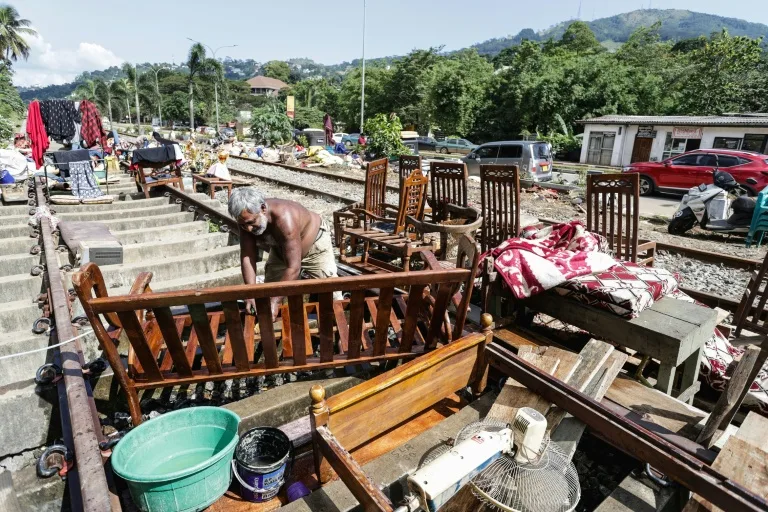
Colombo, Sri Lanka – Sri Lankan authorities have issued fresh landslide warnings as heavy monsoon rains continue to lash regions already devastated by Cyclone Ditwah. The cyclone and accompanying floods have so far claimed 627 lives, with hundreds more missing, making it one of the deadliest natural disasters in the country in recent memory.
The ongoing disaster is part of a broader chain of tropical storms affecting Southeast and South Asia, which has left thousands dead and millions affected across Sri Lanka, Indonesia, Malaysia, Thailand, and Vietnam over the past two weeks.
Cyclone Ditwah Devastates Sri Lanka
Cyclone Ditwah, the worst to hit Sri Lanka this century, triggered widespread flooding and landslides, particularly in the lush tea-growing central highlands and northwestern midlands. More than two million people, nearly 10% of Sri Lanka’s population, have been impacted by the disaster.
The Disaster Management Centre (DMC) warned that monsoon storms are continuing to destabilize hillsides, heightening the risk of additional landslides. Helicopters and planes are being deployed to deliver emergency supplies to isolated communities cut off by flooding and landslides.
The government has confirmed 627 deaths, with 471 from the central region, while approximately 190 people remain unaccounted for. State-run relief camps have seen numbers drop from a peak of 225,000 to around 90,000 as floodwaters recede.
Widespread Damage Across the Country
The cyclone and monsoon rains have caused extensive damage to infrastructure and homes. Over 80,000 houses have been damaged, including nearly 5,000 that were completely destroyed. The government has launched a major compensation and rebuilding program to support affected families and businesses.
Authorities estimate that recovery and reconstruction costs could reach $7 billion, placing a significant strain on Sri Lanka’s post-2022 economic recovery. The International Monetary Fund (IMF) is considering an additional $200 million in aid to support rebuilding efforts, supplementing the $347 million tranche due later this month from an existing $2.9 billion bailout package agreed in 2023.
Indonesia and Regional Impact
Sri Lanka’s disaster is part of a larger regional crisis. Indonesia has also been severely affected, with the death toll climbing to 921, and nearly 400 people missing. President Prabowo Subianto has visited the hard-hit Aceh province to oversee emergency response efforts, including distribution of aid, evacuation, and infrastructure repairs.
Despite the severity of the crisis, the Indonesian government has not declared a national disaster, which would have allowed for faster coordination of resources. Long queues for drinking water and fuel, as well as skyrocketing prices of basic commodities, have compounded the suffering in affected areas.
Government Response and Relief Efforts
In Sri Lanka, the government has pledged compensation packages to help rebuild homes and businesses destroyed by the floods and landslides. Relief efforts are ongoing, with helicopters delivering supplies to cut-off communities, and international aid, including a planeload of relief materials from Myanmar, supporting the response.
President Anura Kumara Dissanayake emphasized that while Sri Lanka’s economy had made progress since the 2022 economic crisis, the country cannot withstand the impact of such a massive natural disaster alone.
Authorities continue to monitor rainfall and landslide risks, urging residents in vulnerable areas to take precautions and follow evacuation instructions.
Key Takeaways
- Cyclone Name: Ditwah
- Location: Sri Lanka, particularly central highlands and northwestern midlands
- Deaths: 627 confirmed, 190 missing
- Affected Population: Over 2 million people
- Damage: 80,000+ homes damaged, including 5,000 destroyed
- International Aid: IMF and Myanmar providing financial and material assistance
- Ongoing Risks: Landslides due to continuous monsoon rains
The disaster highlights the vulnerability of South and Southeast Asia to extreme weather events intensified by climate change, and the urgent need for coordinated disaster management and relief efforts across the region.


Leave a Reply