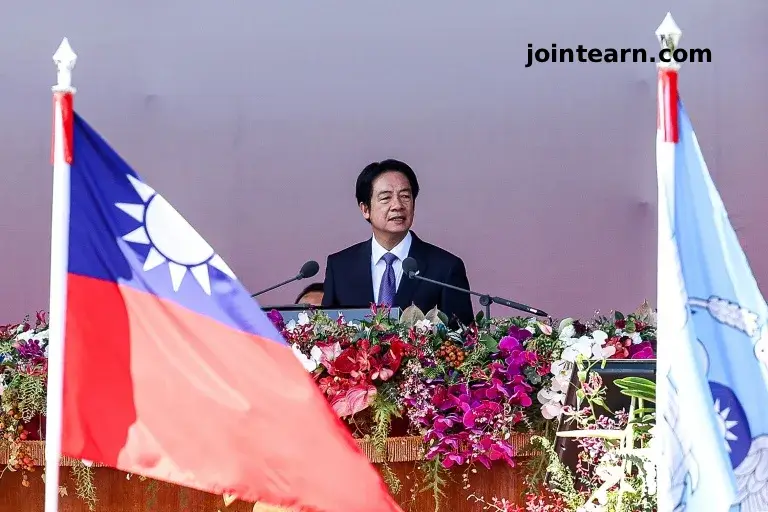
Taipei, Taiwan – Taiwanese President Lai Ching-te announced on Wednesday that his government will propose an additional $40 billion in defence spending over the next eight years, aiming to strengthen Taiwan’s deterrence against potential Chinese aggression. The plan is part of Taiwan’s broader strategy to enhance military readiness amid increasing threats from Beijing.
Boosting Military Capabilities
Taiwan has significantly increased its defence budget over the past decade as pressure from China has intensified. Under Lai’s leadership, the government plans to raise annual defence spending to over three percent of GDP in 2026 and to reach five percent by 2030.
President Lai emphasized that the additional funds will help Taiwan achieve a “high level” of joint combat readiness by 2027, a timeline cited by U.S. officials as a potential window for Chinese military action.
“The ultimate goal is to establish defence capabilities that can permanently safeguard democratic Taiwan,” Lai said during a press conference in Taipei.
The extra $40 billion will fund both arms purchases from the United States and the development of Taiwan’s own defence industry, including asymmetrical warfare capabilities designed to make any potential invasion costly for Beijing.
Key Defence Initiatives
The Taiwanese defence ministry highlighted several projects that will benefit from the new funding, including:
- T-Dome multi-layered air defence system to protect military forces, infrastructure, and civilian areas from missile attacks.
- Long-range precision strike missiles to deter or retaliate against attacks.
- Counter-drone systems and anti-ballistic missile technology.
- Investments in Taiwan’s domestic defence manufacturing to reduce reliance on foreign suppliers.
Military experts praised the plan. Su Tzu-yun of the Taipei Institute for National Defense and Security Research said:
“Freedom is not a free lunch. Taiwan requires this level of preparedness to deter aggression.”
International Support and Arms Sales
President Lai’s announcement comes after the U.S. approved $330 million in military parts and components for Taiwan, marking the first sale since Donald Trump returned to the White House. U.S. officials welcomed Taiwan’s spending plan and urged political consensus to strengthen national defence.
Domestic Political Challenges
While the plan has broad support among Democratic Progressive Party (DPP) lawmakers, it faces opposition in Taiwan’s parliament, where the Kuomintang (KMT), advocating closer ties with China, controls budgetary decisions with support from the Taiwan People’s Party.
KMT chairperson Cheng Li-wun has criticized the plan, saying Taiwan cannot afford such large-scale spending. Lawmaker Ma Wen-chun emphasized the need for more personnel to operate weapons systems, suggesting that recruitment and retention of troops is an urgent priority.
Drew Thompson, a senior fellow at the S. Rajaratnam School of International Studies in Singapore, noted that the success of the plan depends on effective execution and parliamentary approval.
Strategic Significance
The announcement also follows heightened regional tensions between Tokyo and Beijing, after Japanese Prime Minister Sanae Takaichi suggested Japan could intervene militarily in the event of a Chinese attack on Taiwan.
President Lai stressed that the spending plan is not linked to tariff negotiations with the United States, but rather aims to demonstrate Taiwan’s determination to defend itself.
“We aim to bolster deterrence by inserting greater costs and uncertainties into Beijing’s decision-making on the use of force,” he said in a Washington Post opinion piece.


Leave a Reply