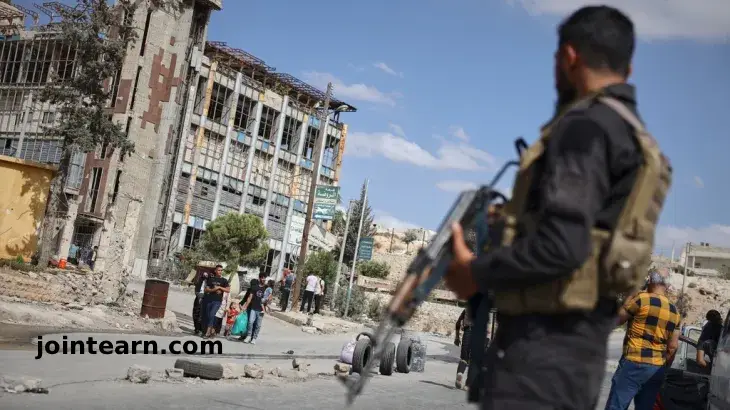
Aleppo, Syria — Fierce clashes between the Syrian government forces and the Kurdish-led Syrian Democratic Forces (SDF) have escalated for a third consecutive day in northern Aleppo, forcing tens of thousands of residents to flee their homes. The violence comes after talks to implement a March 2025 agreement to integrate Kurdish-led forces into Syria’s central government collapsed, raising fears of further instability in the war-torn city.
Curfews and Targeted Operations
The Syrian Army Operations Command imposed a curfew on Thursday at 1:30 PM (10:30 GMT) in the Kurdish-majority neighborhoods of Sheikh Maqsoud, Ashrafieh, and Bani Zeid. Shortly thereafter, the army began what it described as “targeted operations” against SDF positions in these districts. The command also released maps identifying SDF military sites and urged civilians to avoid these areas for safety.
An Al Jazeera team on the ground reported heavy artillery shelling in Ashrafieh, while the SDF claimed intense clashes in the nearby Syriac Quarter and areas north of the city. Both sides accuse each other of endangering civilians trying to leave the conflict zones.
“You can hear artillery shelling that is ongoing and intensifying here,” said Al Jazeera reporter Resul Serdar.
Massive Displacement
According to local sources, more than 138,000 residents have fled Sheikh Maqsoud and Ashrafieh, seeking safety in humanitarian corridors established by the Syrian army. Many carried whatever belongings they could manage, while others used buses provided by authorities. Still, tens of thousands remain in these neighborhoods, exposed to continued shelling and urban combat.
“We fled the clashes, and we don’t know where to go,” said Ahmed, a 38-year-old resident, carrying his young son. “Fourteen years of war, I think that’s enough.”
Residents who stayed behind have taken refuge in mosques and schools, but these locations lack sufficient resources and shelter capacity to meet growing humanitarian needs.
Humanitarian and Civilian Impact
The fighting has resulted in civilian casualties, with the SDF reporting at least eight deaths, while government officials confirmed five civilians killed and dozens injured. Hospitals and clinics are struggling to cope with the surge of casualties, and schools, universities, and government offices in Aleppo remain closed. Flights to and from Aleppo’s airport were suspended due to the conflict.
Humanitarian observers warn that the prolonged clashes may trigger a major humanitarian crisis, as residents face restricted access to food, water, and medical care.
Political Background: The Failed SDF Integration Deal
The current escalation follows the collapse of US-mediated negotiations aimed at integrating the SDF into Syria’s central government institutions. The March 2025 agreement sought to merge all civil and military structures in northeastern Syria into the state, including control over border crossings, airports, and oil and gas fields.
Syrian Information Minister Hamza al-Mustafa accused the SDF of violating the agreement over 100 times, citing civilian casualties and security incidents. Meanwhile, the SDF insists it has no military presence in Aleppo’s neighborhoods and claims the Syrian army’s actions risk turning Syria into an open battlefield once again.
“The continuation of hostilities could escalate the conflict and destabilize the region further,” an SDF spokesperson warned.
Sectarian and Regional Dimensions
The conflict in Aleppo reflects deeper struggles over control, minority inclusion, and post-war governance in Syria. Analysts point out that President Ahmed al-Sharaa’s government faces a delicate balancing act: integrating diverse groups while maintaining order in a country still recovering from 14 years of civil war.
Security experts also highlight regional tensions, including Israel’s ongoing military strikes across Syria and the US’s strategic interests in preventing Iranian influence from filling any power vacuums.
“What we are looking at is a race between integration and disintegration,” said Muhanad Seloom, assistant professor in critical security studies at the Doha Institute.
International Response
The United Nations expressed concern over the violence, urging all actors to de-escalate and protect civilians. The UN called for “maximum restraint” and the prompt resumption of negotiations to implement the March integration agreement.
Turkey’s Ministry of National Defense said it is closely monitoring developments and stands ready to assist Syria if requested.
Aleppo: A City at a Crossroads
Aleppo, once a thriving cultural and economic hub, now faces yet another wave of destruction and displacement. As fighting continues, residents grapple with uncertainty, fear, and the challenge of survival amid the collapse of political agreements.
“Civilians are paying the price once again,” said reporter Serdar. “This is not just a local security incident; it reflects Syria’s unresolved political future and the fragility of post-war peace.”
With no immediate resolution in sight, the fate of Aleppo’s residents—and Syria’s broader efforts to stabilize—remains uncertain.


Leave a Reply