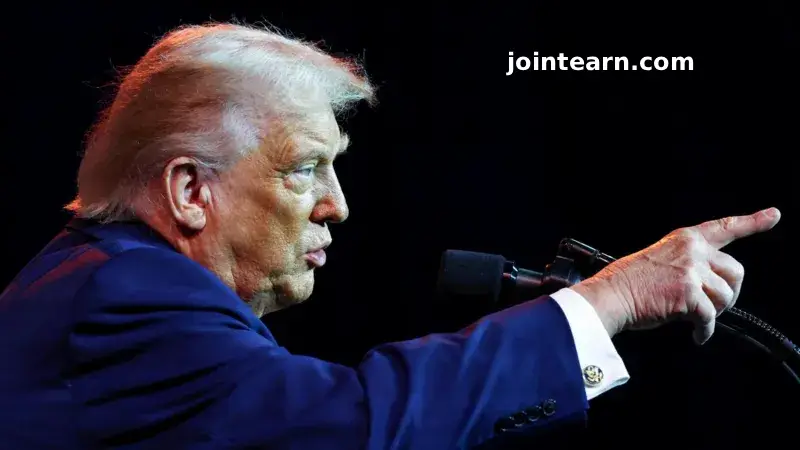
US President Donald Trump has issued a warning that additional airstrikes may be carried out in Nigeria if reports of attacks against Christians continue. This statement comes in the wake of Christmas Day strikes in Nigeria’s Sokoto state, where US forces targeted militant camps in a move Trump described as a “Christmas present.”
Trump Signals More Strikes If Violence Persists
In an interview with the New York Times, President Trump was asked whether the strikes on Islamist militant groups in Sokoto were part of a larger military campaign in Nigeria. He replied:
“I’d love to make it a one-time strike. But if they continue to kill Christians, it will be a many-time strike.”
Trump’s comments highlight his concern over the security of Christians in Nigeria, whom he has described as facing an “existential threat.” Last year, he labeled Nigeria a “country of particular concern” due to alleged violence against the Christian population.
Nigeria Responds: Protection for All Citizens
Nigeria’s government has rejected claims that it fails to protect Christians, stating that Muslims, Christians, and those of no faith alike are targeted by militants. A spokesperson for Nigeria’s foreign minister, Alkasim Abdulkadir, emphasized:
“We will continue to engage constructively and work with partners, including the United States, on the basis of mutual respect, international law, and Nigeria’s sovereignty. Nigeria remains committed to protecting all citizens, Christians and Muslims alike, without discrimination.”
With a population exceeding 230 million people, Nigeria is roughly evenly divided between Christians, primarily in the south, and Muslims, largely concentrated in the north.
The Complex Security Landscape in Nigeria
The north-east of Nigeria has faced a devastating Islamist insurgency for over 15 years, primarily from jihadist groups such as Boko Haram and factions affiliated with the Islamic State (IS). In addition to jihadist activity, Nigeria contends with criminal kidnapping gangs, land disputes, and separatist movements in various regions, complicating national security efforts.
The Christmas Day airstrikes specifically targeted two camps operated by a militant group called Lakurawa, based in north-western Nigeria near the border with Niger. Although both the US and Nigerian governments have not released casualty figures, officials maintain that the operation aimed to neutralize militants linked to IS groups in the Sahel. The Islamic State has not publicly confirmed any connection to Lakurawa.
Joint Operation with Nigerian Forces
Nigeria’s Foreign Minister Yusuf Maitama Tuggar confirmed that the strikes were a joint operation with the Nigerian military and did not target any specific religious group. He emphasized that the timing of the strikes had no religious significance, despite Trump framing them as a Christmas gift. The strikes received explicit approval from Nigerian President Bola Tinubu and were carried out with the involvement of the country’s armed forces.
Ongoing Debate Over Religious Targeting
Claims of a genocide against Christians in Nigeria have circulated in some right-wing US media, but monitoring organizations report that many victims of jihadist violence are Muslims. Trump acknowledged this in the interview, stating:
“I think that Muslims are being killed also in Nigeria. But it’s mostly Christians.”
The situation has drawn international attention, raising questions about US military involvement in Africa, the protection of religious minorities, and the enforcement of counterterrorism operations in volatile regions.
Looking Ahead: US-Nigeria Cooperation
Despite tensions, both the US and Nigerian governments have pledged ongoing cooperation in counterterrorism efforts. Analysts suggest that future airstrikes will likely focus on strategic operations against militant strongholds while balancing Nigeria’s sovereignty and regional stability.
As Nigeria continues to grapple with jihadist violence and other security challenges, the international community is closely monitoring developments to ensure civilian protection and minimize escalation.


Leave a Reply