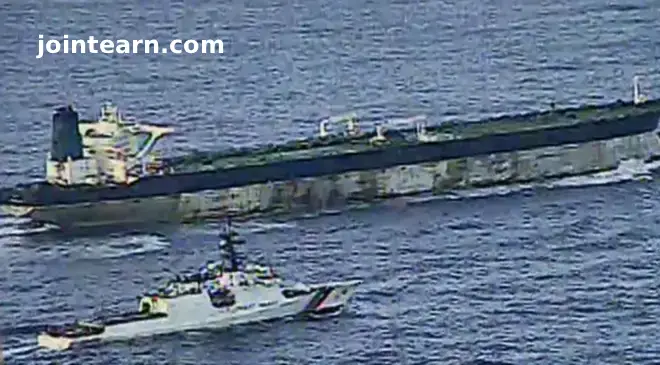
In a significant escalation of its maritime enforcement campaign, the United States has seized its fifth oil tanker tied to Venezuelan crude exports, as part of a broader effort to enforce sanctions and tighten control over Venezuela’s oil distribution. This latest operation underscores Washington’s commitment to disrupting what it calls a “shadow fleet” of vessels that transport embargoed or illicit oil across international waters.
Pre‑Dawn Seizure of the Aframax Tanker Olina
Early on January 9, 2026, U.S. military and Coast Guard forces successfully intercepted and seized the Aframax‑class oil tanker Olina in the Caribbean Sea, marking the fifth such interdiction in recent weeks. The U.S. Southern Command confirmed that the vessel was apprehended without incident during a coordinated pre‑dawn operation involving Marines, sailors, and Department of Homeland Security personnel.
According to maritime records, Olina — previously known as Minerva M — had been sailing under a false flag registered to Timor‑Leste, a tactic commonly used to evade detection while transporting sanctioned oil. The tanker was sanctioned by the U.S. Treasury in late 2025 for its role in transporting Russian and Venezuelan crude, and also faces sanctions from the United Kingdom and European Union.
Part of a Broader Campaign Against the “Shadow Fleet”
U.S. authorities describe the Olina and similar vessels as part of a so‑called “shadow fleet” — loosely regulated tankers that deliberately turn off tracking systems and use false registrations to carry embargoed oil out of Venezuela. Washington’s campaign aims to dismantle these maritime networks and enforce international sanctions against the Maduro regime and its trading partners.
This latest interception follows several previous seizures, including other sanctioned tankers targeted in the Atlantic and Caribbean, which the U.S. says were involved in moving crude oil in violation of sanctions and international law.
U.S. Strategy and Legal Justifications
Officials maintain that these actions are legal under U.S. and international law, especially in cases where vessels are deemed stateless due to false flag registrations, allowing boarding and seizure under maritime jurisdiction rules. In Olina’s case, maritime tracking data showed the vessel had gone dark for extended periods before U.S. forces intercepted it.
U.S. Homeland Security Secretary Kristi Noem labeled Olina another vessel from the “ghost fleet” suspected of transporting embargoed oil and underscored that such operations are crucial for enforcing economic sanctions and curbing illicit petroleum trades.
Political Context and Diplomatic Movement
The tanker seizure comes amid heightened tensions between the U.S. and Venezuelan authorities. Just days before the Olina interception, U.S. forces conducted a high‑profile raid against Venezuelan President Nicolás Maduro, adding pressure on Caracas. In parallel, U.S. officials have dispatched diplomats to Caracas to explore reopening the U.S. embassy, a significant shift after ties were severed in 2019.
While U.S. policymakers argue these actions help enforce sanctions and combat corruption, critics both domestically and internationally — including in Caracas, Moscow, and Beijing — have portrayed the seizures as provocative and potentially destabilizing. Venezuelan allies have condemned the actions as acts of “maritime piracy” and violations of sovereign trade rights.
What’s Next for Venezuela’s Oil Exports and U.S. Policy
President Donald Trump has signaled a broader strategy to bring Venezuelan oil revenues under U.S. control, including plans to sell seized crude on international markets and direct proceeds to benefit Venezuelan citizens. Meanwhile, energy markets are closely watching the disruptions to traditional Venezuelan export routes and the effects of the U.S. “blockade” on global oil flows.
As U.S. authorities continue to track and seize sanctioned tankers linked to Venezuela, the geopolitical and economic implications for Western Hemisphere energy supply remain a subject of intense scrutiny.


Leave a Reply