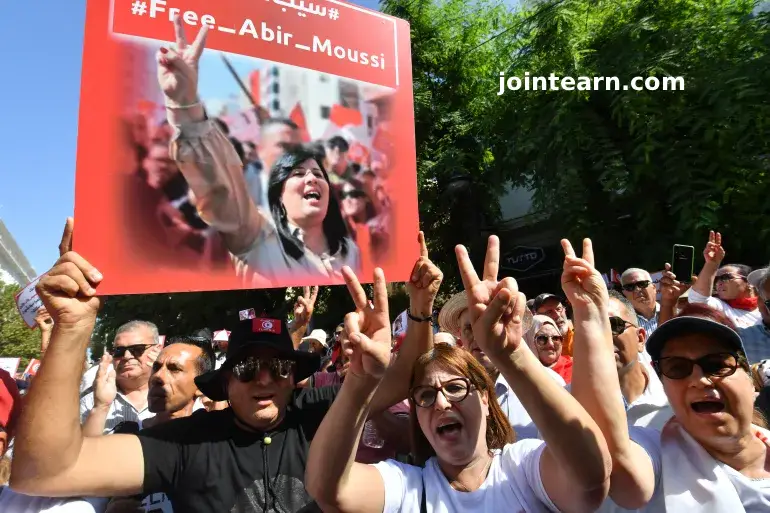
In a landmark ruling that has sparked international concern, prominent Tunisian opposition leader Abir Moussi has been sentenced to 12 years in prison. The decision comes amid a sweeping crackdown on critics of President Kais Saied, who has repeatedly claimed he is purging the country of “traitors” undermining national stability.
Moussi, the president of the Free Destourian Party (also known as the Free Constitutional Party), was represented by lawyer Nafaa Laribi during her third trial in just two years. Laribi condemned the ruling as “unjust,” describing it as “not a judicial decision but a politically motivated order.”
Background on Abir Moussi and the Free Destourian Party
Abir Moussi has led the Free Destourian Party since 2016 and was previously a supporter of the late President Zine El Abidine Ben Ali, who was ousted in the 2011 Arab Spring revolution. Her party has consistently criticized President Saied’s consolidation of power, including his 2021 decision to dissolve the elected parliament and rule by decree—a move he claimed was necessary to prevent national anarchy.
Moussi was first arrested in October 2023 at the presidential palace on allegations of assault intended to cause chaos. Her detention was part of a broader crackdown targeting journalists, activists, civil society groups, and political opponents. She has rejected all charges, asserting that she was exercising her democratic right to criticize government actions and pledging to continue resisting “abuse, torture, and political and moral violence.”
The Legal Context
This latest 12-year sentence relates to Moussi’s 2023 arrest. Previously, she was sentenced to two years under Decree 54, a controversial law introduced by Saied in 2022 aimed at combating “false news.” That sentence was later reduced on appeal. After completing her first term last June, Moussi was sentenced again under the same decree, with the appeal process still ongoing.
Critics argue that Decree 54 is being used as a tool to criminalize dissent, suppress free speech, and silence political opposition. Human rights organizations have repeatedly condemned the law and Saied’s broader campaign against political rivals.
National and International Reactions
While Moussi’s detractors accuse her of advocating a return to the authoritarianism of Ben Ali’s era, human rights groups and opposition figures point to Saied’s dismantling of judicial independence as evidence of authoritarian consolidation. Since 2021, the Saied administration has dissolved the Supreme Judicial Council, removed dozens of judges, and intensified prosecutions of opposition leaders, moves widely described as undermining the rule of law.
Dozens of opposition figures have recently received harsh prison sentences in mass trials for alleged conspiracy against state security, raising alarms among international observers. Rights advocates warn that Tunisia, once celebrated as a beacon of democracy in the Arab world after the Arab Spring, is experiencing a deep erosion of democratic norms and civic freedoms.
Implications for Tunisia’s Democracy
Abir Moussi’s imprisonment highlights the increasingly perilous environment for political dissent in Tunisia. Analysts suggest that the heavy-handed measures may further weaken democratic institutions and exacerbate political polarization. The international community continues to monitor Tunisia’s political trajectory, calling for judicial independence, the protection of political rights, and adherence to democratic principles.
As the Saied government continues to consolidate power, Moussi’s case underscores the growing tension between political authority and democratic accountability in Tunisia, raising questions about the future of free expression, opposition politics, and the rule of law in the country.


Leave a Reply