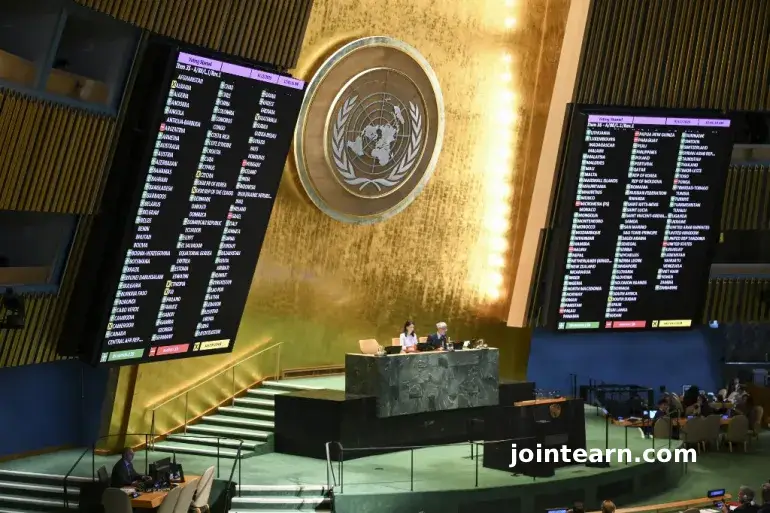
In a significant development at the United Nations, the General Assembly has overwhelmingly passed a resolution demanding that Israel allow unrestricted humanitarian access to the Gaza Strip, halt attacks on UN facilities, and comply with international law as an occupying power.
The vote, held on Friday, came in the wake of the International Court of Justice’s (ICJ) October advisory opinion, which clarified Israel’s responsibilities under both the UN Charter and international humanitarian law. The ICJ’s opinion emphasized that Israel, as the occupying power, has clear legal obligations to ensure the protection and well-being of civilians in Gaza.
Voting Outcome and Global Support
The resolution, tabled by Norway alongside more than a dozen co-sponsoring countries, received broad international backing. A total of 139 UN member states voted in favor, signaling widespread support for humanitarian access and legal accountability. Only 12 countries, including Israel and the United States, voted against it, while 19 nations abstained.
Norway’s Permanent Representative to the UN, Merete Fjeld Brattested, highlighted the urgency of the resolution, noting that 2024 and 2025 have been among the most violent years in decades in the occupied Palestinian territory. She emphasized that civilians are bearing the highest toll and that respect for humanitarian principles is rapidly eroding.
“Member states have sought legal clarity on fundamental issues relating to the provision of life-saving humanitarian assistance to the civilian population in Palestine,” Brattested said, underscoring the importance of the ICJ’s advisory proceedings in defining state responsibilities.
Humanitarian Concerns in Gaza
Despite the ceasefire brokered by the United States in October, Israel has only allowed a fraction of the agreed-upon humanitarian aid into Gaza. Recent attacks, including Israel’s incursion into UNRWA’s Sheikh Jarrah compound, have drawn condemnation from UN Secretary-General Antonio Guterres. Brattested pointed out that such actions violate Israel’s obligations to respect the inviolability of United Nations premises.
Philippe Lazzarini, the UNRWA Commissioner-General, welcomed the resolution, calling it “a strong endorsement” of the ICJ’s findings that allegations of Hamas infiltration inside UNRWA are unsubstantiated and that the agency maintains neutrality in its operations.
International Reactions
The United States opposed the resolution, with US envoy Jeff Bartos asserting that the vote “exemplifies how even following President Trump’s landmark peace agreement and the historic passage of Security Council resolution 2803, the General Assembly continues its decades-long pattern of unfairly targeting Israel.”
Meanwhile, Palestinian officials praised the resolution’s adoption. Rouhi Fattouh, Speaker of the Palestinian National Council, described the vote’s wide margin as a “firm international position supporting UNRWA and renewing recognition of its legal mandate in protecting Palestinian refugees.” He warned that the humanitarian situation in the occupied Palestinian territory is worsening due to rising occupation-related crimes and potential ethnic cleansing.
Implications for International Law and Humanitarian Aid
The UN General Assembly’s resolution represents a critical reaffirmation of international law and humanitarian obligations. It underscores the role of the international community in holding occupying powers accountable and ensuring that humanitarian aid reaches those in dire need. Analysts say the resolution could increase pressure on Israel to comply with international norms and facilitate safe delivery of aid to Gaza, while also serving as a precedent for future humanitarian interventions.
As tensions continue in the region, the international community is watching closely. The resolution sends a clear message that compliance with international law and protection of civilians remain central to UN principles, and that the world expects member states to uphold these responsibilities.


Leave a Reply