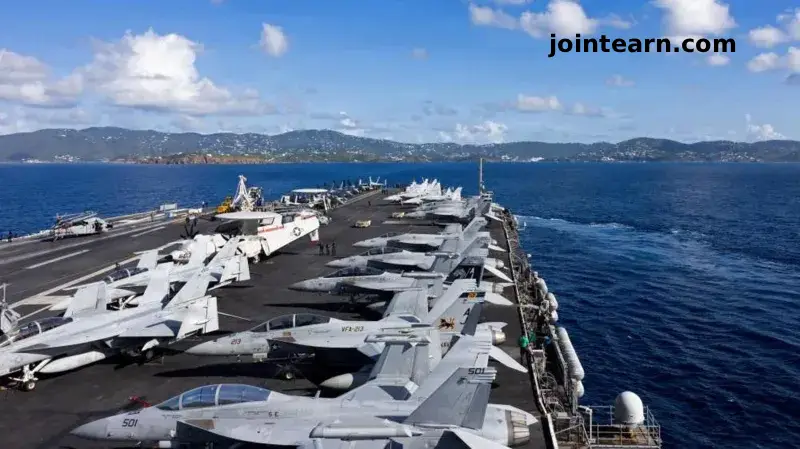
The escalating tension between the United States and Venezuela has led to the largest US military deployment in the Caribbean since the end of the Cold War. With the deployment of the USS Gerald Ford, the world’s largest aircraft carrier, and thousands of troops, the US is signaling its intent to pressure Venezuelan leader Nicolás Maduro amid allegations of drug trafficking and narco-terrorism.
While comparisons have been drawn to the 1989 US invasion of Panama, experts emphasize that the current situation is markedly different in terms of strategy, international law, and geopolitical stakes.
Historical Parallel: Panama 1989
The last time the US conducted a major military operation in the Caribbean was in December 1989, when it removed Panama’s President Manuel Noriega from power, accusing him of involvement in drug trafficking.
An incident on 16 December, when US Marine Lt Robert Paz was killed at a Panamanian checkpoint, triggered the US invasion known as Operation Just Cause. Over 30,000 US troops were mobilized, Noriega was captured and taken to the United States, and approximately 500 Panamanian civilians were killed according to UN estimates.
Both then and now, Washington cited drug trafficking as a key justification for its military actions, emphasizing the threat posed by a leader allegedly involved in illegal activities. The Panama Canal’s strategic importance in 1989 mirrors Venezuela’s vast oil reserves in today’s conflict.
Key Differences Between Panama and Venezuela
Despite the historical parallels, significant differences make the current situation unique:
- Leadership and Context – George H.W. Bush led the US during the Panama invasion, while Donald Trump directs today’s military actions. Noriega was a former CIA asset with extensive documented evidence linking him to the Medellín Cartel. Maduro, by contrast, denies direct involvement in organized drug trafficking, though allegations of the Cartel of the Suns and family involvement persist.
- Nature of the Conflict – The US defines its current operations in Venezuela as a “non-international armed conflict”, targeting alleged drug trafficking vessels in the Caribbean under the premise of narco-terrorism. This differs from the conventional invasion of Panama.
- Legal Controversies – The Trump administration has faced criticism over recent strikes on drug-smuggling boats, including allegations that a follow-up strike may have resulted in extrajudicial killings. Video footage of the incidents has only been shown to select members of Congress. The Pentagon maintains the strikes were lawful under the rules of engagement, but questions about legality and transparency remain.
Venezuela and Narco-Terrorism Allegations
The US accuses Maduro of heading the Cartel of the Suns, a network allegedly comprising members of Venezuela’s top military. Critics argue that the cartel is not a formal criminal organization but a loose alliance involved in corruption and drug smuggling.
Evidence of drug trafficking exists within Maduro’s extended family:
- In 2015, two of Maduro’s nephews were arrested in Haiti while attempting to smuggle 800kg of cocaine to the US. Known as the “narco-nephews,” they served time in US prison before returning to Venezuela in 2022.
- The Trump administration recently imposed new sanctions on the nephews and a third relative, citing their role in spreading drugs to the US.
US Treasury Secretary Scott Bessent said the sanctions hold Maduro and his associates accountable for “flooding the United States with drugs that are poisoning the American people.”
Current Military Build-Up in the Caribbean
The US has deployed a large naval armada including the USS Gerald Ford and thousands of troops, creating a blockade-like presence around Venezuela. This build-up is connected to broader efforts by the Trump administration to:
- Intercept vessels allegedly carrying drugs to the US.
- Enforce sanctions on Venezuelan oil tankers, including the seizure of the Skipper.
- Pressure Maduro’s government politically and economically.
While some lawmakers, including Congressman Joaquin Castro, have criticized these moves as an “act of war”, the White House has defended its actions as part of a lawful anti-drug and counter-narco-terrorism strategy.
Escalating Tensions and Risk of Conflict
The situation in Venezuela remains volatile. Analysts warn that, much like the killing of Lt Robert Paz in Panama 1989 triggered a full-scale invasion, a single misstep in Venezuela could escalate into a larger military confrontation.
Trump has signaled that once US forces control the airspace and seas around Venezuela, the next target could be land operations. However, a negotiated solution remains a possibility, albeit one that would require significant compromise from both the Maduro administration and the White House.


Leave a Reply