Washington, D.C., December 5, 2025 — The United States Supreme Court has cleared the way for Texas to implement a controversial congressional district map ahead of the 2026 midterm elections. The ruling, split along ideological lines, allows the Republican-backed map—championed by former President Donald Trump and Texas state leaders—to take effect despite lower court findings that it amounted to racial gerrymandering.
This landmark decision is expected to influence redistricting strategies nationwide, intensifying debates over partisan gerrymandering and voting rights.
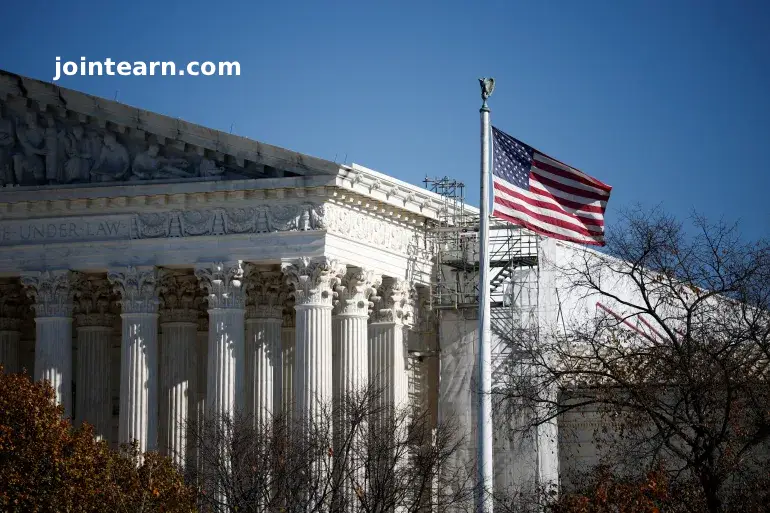
![US Supreme Court building, file photo: Benoit Tessier/Reuters]
Supreme Court Ruling and Split Decision
The Supreme Court’s conservative majority, consisting of six justices, approved the new Texas congressional map, overruling a November decision by the U.S. District Court for Western Texas that had blocked the map’s use. The lower court found that Texas had racially gerrymandered districts, violating constitutional protections under the Fourteenth and Fifteenth Amendments.
The Supreme Court issued a brief, unsigned order, citing precedent that “lower courts should ordinarily not alter election rules on the eve of an election,” warning that doing so would inflict “irreparable harm” on the state. The conservative justices concluded that Texas was likely to prevail on the merits of its claims.
In dissent, the three liberal justices—including Justice Elena Kagan—argued that the Court ignored extensive evidence presented in the lower court. Kagan emphasized that the district court had conducted a nine-day hearing with testimony from nearly two dozen witnesses and introduced thousands of exhibits, concluding that the map intentionally diluted the voting power of Black and Latino communities.
Background: Trump, Abbott, and the Push for Partisan Redistricting
The controversy began in June 2025, when reports surfaced that former President Donald Trump was encouraging Texas state legislators to adopt a new congressional map that would favor Republicans. The map is projected to give the GOP five additional seats in the U.S. House of Representatives, bolstering the party’s narrow majority.
Texas, the second most populous U.S. state, currently holds 38 congressional seats, with Republicans occupying 25 of them. Democrats are strategizing to flip the House in the 2026 midterms, especially as Trump’s approval rating has reportedly dropped to 36%, according to a Gallup poll.
Despite Democratic attempts to halt the process—including leaving the state to block votes—the Republican-led Texas legislature finalized the new map in August 2025. This sparked a nationwide redistricting trend, with other states pursuing partisan advantages:
- Missouri Republicans passed a gerrymandered map in September, adding one projected House seat.
- North Carolina Republicans enacted a similar plan in October, also gaining one expected seat.
- California Democrats introduced a ballot initiative in November to replace the state’s independent commission with a new partisan map, potentially gaining five additional seats to counter Texas.
Legal and Constitutional Implications
Partisan gerrymandering—manipulating electoral district boundaries to favor one political party—is a contentious issue in U.S. politics. While federal courts have ruled that race-based gerrymandering is illegal, they have generally avoided judging purely partisan map drawing. The Supreme Court has repeatedly stated that federal courts cannot intervene solely on the basis of political bias.
The Texas case, Greg Abbott v. League of United Latin American Citizens, centered on allegations that the new map diluted the influence of minority voters. The Supreme Court, however, found that the district court failed to adequately consider legislative intent and treated ambiguous statements as conclusive evidence of racial bias.
Justice Samuel Alito noted that distinguishing between partisan and racial gerrymandering is complex, as voting patterns often correlate with race. Plaintiffs must therefore demonstrate a clear difference between lawful partisan redistricting and unconstitutional race-based manipulation.
Reactions and Political Fallout
Republicans hailed the decision as a victory. Texas Governor Greg Abbott celebrated on social media, stating:
“Texas is officially — and legally — more red. The Supreme Court restored the congressional redistricting maps that add five more Republican seats.”
Texas Attorney General Ken Paxton emphasized the state’s right to draw districts reflective of its political values, framing the decision as a defense against Democratic efforts to manipulate elections.
Democrats, however, condemned the ruling. Representative James Talarico commented:
“Voters are supposed to choose their politicians — not the other way around. We will continue fighting for fair representation.”
Justice Kagan criticized the Supreme Court’s approach, noting that the lower court had meticulously reviewed thousands of pages of evidence, only for the high court to overturn it in a brief emergency order.
The Road to the 2026 Midterms
The ruling comes at a critical moment, as candidates begin campaigning across the newly drawn districts. Texas Republicans are expected to capitalize on the map to strengthen their congressional majority, while Democrats prepare legal challenges and political strategies to mitigate losses.
Meanwhile, similar legal battles are underway in other states, including ongoing federal lawsuits against California’s redistricting initiative. Observers warn that the 2026 midterms may be shaped as much by district lines as by voter turnout, intensifying concerns about the fairness of U.S. elections.


Leave a Reply