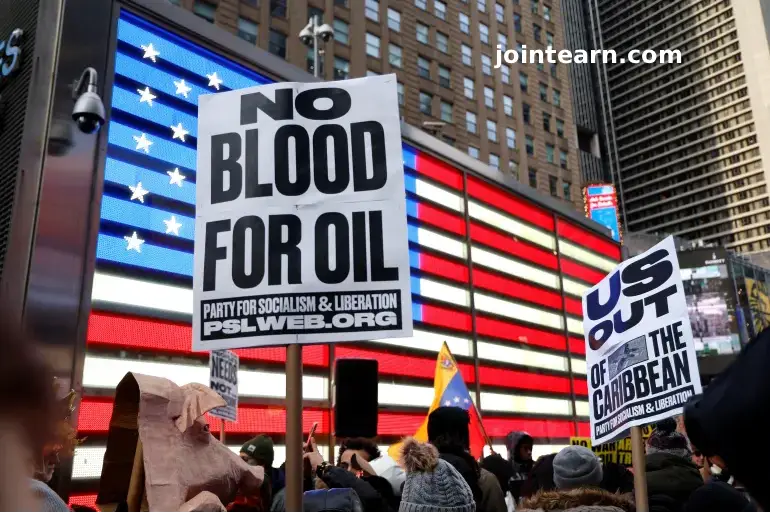
The US military intervention in Venezuela and the capture of President Nicolás Maduro have sent shockwaves across Latin America and beyond. While the action reverberates politically, its immediate impact on global oil markets has been surprisingly muted. Yet for the Middle East and North Africa, Venezuela’s unfolding crisis serves as a stark reminder that oil, even in an era of abundant supply, continues to influence geopolitics in profound and often dangerous ways.
The US Operation in Caracas
Images from Caracas shocked observers with their familiar, yet dramatic, display: armored vehicles patrolling empty streets, and Maduro being taken into custody by US forces. Washington quickly hailed the operation as “decisive, necessary, and complete,” with former President Donald Trump warning of a “second, bigger wave” should any resistance emerge.
While the action has dominated headlines, its ripple effects extend far beyond Venezuela’s borders, touching energy security, geopolitical strategy, and global oil markets.
Venezuela’s Oil Riches and Production Collapse
Venezuela is home to 303 billion barrels of proven oil reserves, exceeding those of Saudi Arabia and accounting for roughly 17 percent of global reserves. Yet production tells a very different story.
According to OPEC, Venezuela produced just 934,000 barrels per day in November 2025—less than 1 percent of global demand and a shadow of its 3 million barrels per day output in the late 1990s and early 2000s.
The decline began under Hugo Chávez, continued under Maduro, and was exacerbated by US sanctions in 2019, which targeted PDVSA, the state oil company. The sanctions restricted oil-for-debt swaps, halted exports to key markets like India and the EU, and cut off access to essential diluents for processing heavy crude.
The economic consequences were catastrophic: hyperinflation, collapsing salaries, and a humanitarian crisis that fueled the mass exodus of nearly 8 million Venezuelans.
Market Reaction: Why Oil Prices Didn’t Spike
Despite the dramatic political intervention, oil prices fell. Brent crude dropped to around $60 per barrel, and WTI fell below $58. Analysts attribute this to a global oil oversupply, with new production from Brazil, Guyana, Argentina, and the US, coupled with OPEC+ unwinding cuts of nearly 4 million barrels per day.
Energy experts like Carole Nakhle, CEO of Crystol Energy, emphasize that rebuilding Venezuela’s oil industry will take years and hundreds of billions of dollars in investment. Immediate market disruption is unlikely, and any return of Venezuelan barrels would represent less than 1 percent of global supply.
The Strategic Importance of Heavy Crude
Venezuela’s significance lies not in volume alone but in the quality of its crude. Most Venezuelan oil is heavy, ideal for many US Gulf Coast refineries. While these refineries have adapted to other sources, Venezuelan heavy crude remains crucial for certain refining processes.
US intervention opens the door for American companies, particularly Chevron, to gradually restore output. Analysts predict that, over time, this could place downward pressure on oil prices, potentially under $50 per barrel, affecting competitors such as Canada.
Middle East Implications
For Middle Eastern producers, Venezuela’s revival does not threaten output. Countries like Saudi Arabia and Iraq operate at a scale far beyond Venezuela’s near-term production potential.
However, the US intervention sets a precedent, reminding global powers that unilateral actions can reshape regional dynamics. Lessons from Iraq and Libya indicate that interventions rarely remain contained, often producing long-term instability with widespread political and economic consequences.
Carole Nakhle notes that instability, rather than oil supply, represents the real market risk: “Markets can handle Venezuelan barrels. They cannot easily price prolonged political disorder.”
Beyond Oil: Strategic Underpinnings
US officials emphasize that the intervention was not purely about energy. Venezuela has strategic ties to China, which controls significant refining capacity and has invested heavily in Venezuelan mining operations. Russia has reportedly deployed military advisers, and Iran has set up drone facilities—making Venezuela a geopolitical pivot in the Americas.
Trump’s intervention also underscores concerns over the petrodollar, as Venezuela had increasingly accepted yuan and aligned with BRICS nations. Yet experts argue that oil trading today is diverse, and the US dollar’s role is based on financial depth rather than coercive enforcement.
The Long Road Ahead
While US companies may help rebuild Venezuela’s oil sector, history cautions patience. Iraq and Libya illustrate that government change does not guarantee industrial recovery. Oil infrastructure and institutional reform require years of investment and expertise, and Venezuela’s reserves, while immense, are still largely underground.
The coming years will determine whether Venezuela becomes a source of stability or another chapter in the historical interplay of oil and conflict.


Leave a Reply