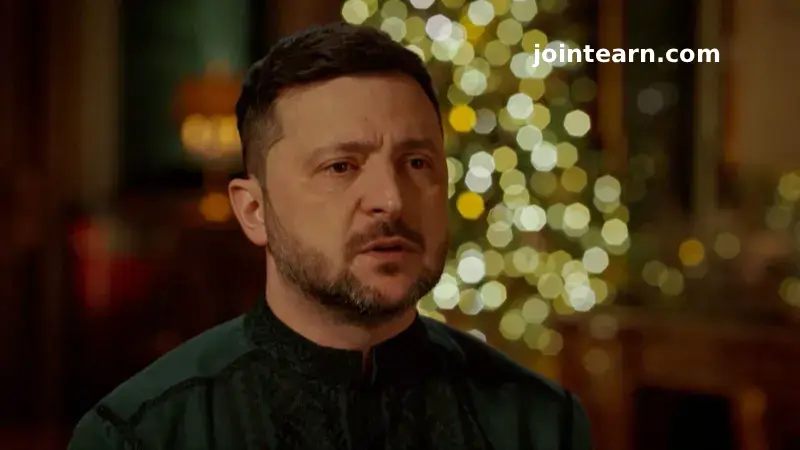
Ukrainian President Volodymyr Zelensky has announced that a peace agreement to end the war with Russia is “90% ready”, in a New Year address that highlighted Ukraine’s continued resistance to Moscow’s full-scale invasion and the importance of security guarantees for the country and Europe.
Zelensky stressed that the remaining 10% of negotiations will determine the fate of peace, Ukraine, and Europe, signaling that the most challenging issues remain unresolved.
Key Points from Zelensky’s Address
In his 20-minute televised speech, Zelensky underscored that Ukraine does not seek peace “at any cost”, saying:
“We want the end of the war – not the end of Ukraine.”
He highlighted the Donbas region as a critical obstacle in negotiations. Ukraine has rejected Moscow’s maximalist demands for full control over Donetsk and Luhansk, which Russia currently occupies at approximately 75% and 99%, respectively. Zelensky warned that any Ukrainian withdrawal from Donbas would effectively endanger Ukraine’s sovereignty.
The president also thanked international allies while emphasizing that support must translate into actionable security guarantees. He mentioned discussions with US President Donald Trump in Florida, where Washington reportedly offered 15-year security guarantees, though a timeline for implementation remains uncertain.
“Signatures under weak agreements only fuel war,” Zelensky said. “Either the world stops Russia’s war, or Russia drags the world into its war.”
Russian Response and Tensions
Russian President Vladimir Putin delivered a shorter New Year address, framing the conflict as a “special military operation”. Putin praised Russian troops and highlighted domestic support measures, without acknowledging peace negotiations.
Earlier, Russia released alleged evidence of a Ukrainian drone attack on Putin’s private residence at Lake Valdai, which Ukraine denies. Moscow claimed the drones were launched from Sumy and Chernihiv regions and displayed a video of a downed drone. The Kremlin stated the incident would influence its position on ongoing negotiations.
The EU’s top diplomat, Kaja Kallas, dismissed Russia’s claims as a “deliberate distraction”, designed to undermine the peace process.
International Support and Diplomatic Talks
Zelensky expressed hope that peace negotiations would resume and accelerate in January with the participation of US and European officials. French President Emmanuel Macron stated that European allies meeting in Paris on 6 January would make concrete commitments to protect Ukraine and ensure a just and lasting peace.
US special envoy Steve Witkoff confirmed discussions with Zelensky and advisers from the UK, France, and Germany, focusing on:
- Strengthening security guarantees for Ukraine
- Developing deconfliction mechanisms to prevent future escalation
- Ensuring the conflict does not reignite after a ceasefire
Despite these diplomatic efforts, Zelensky acknowledged that any agreement requires Russian buy-in, which remains uncertain. The alleged drone strike over Putin’s residence may have further delayed prospects for a final deal.
Context: The Donbas and Ukraine’s Security
The Donbas region, comprising Donetsk and Luhansk, remains a major sticking point. Russia insists on controlling the industrial area, while Ukraine maintains that surrendering the territory would compromise its sovereignty and national security.
Zelensky’s address highlights Ukraine’s dual focus on ending the war and preserving its territorial integrity, reflecting the delicate balance in peace negotiations with Moscow.
The president’s speech also emphasized the need for actionable international guarantees, suggesting that future agreements will involve long-term commitments from the US and European allies to secure Ukraine against potential future aggression.


Leave a Reply