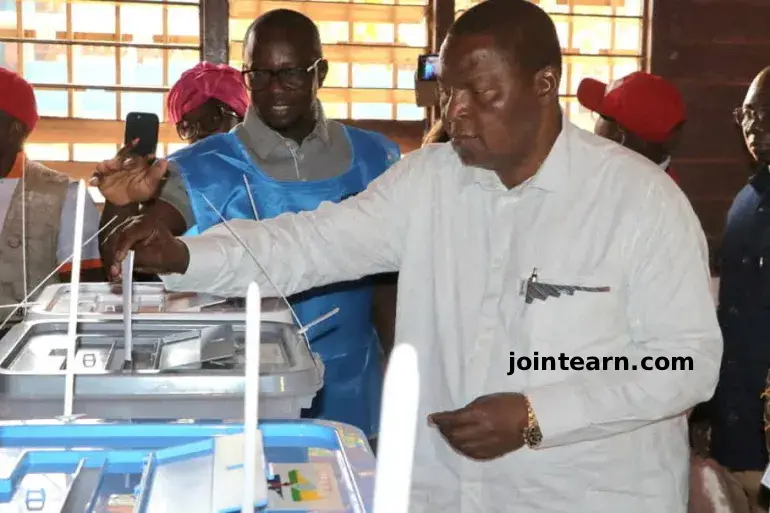
Faustin-Archange Touadera, the incumbent President of the Central African Republic (CAR), has secured a historic third term in office, according to provisional results from the December 28, 2025, presidential election.
Preliminary figures released on Monday show Touadera receiving 76.15 percent of the vote, a commanding lead over his closest competitors. Former Prime Minister Anicet-Georges Dologuele received 14.66 percent, while another former Prime Minister, Henri-Marie Dondra, earned 3.19 percent of ballots cast. Voter turnout was reported at 52.42 percent.
Background: A Controversial Third Term
Touadera, 68, a mathematician by training, first assumed office a decade ago. His bid for a third term follows a constitutional referendum in 2023, which removed the presidential term limits, paving the way for incumbents to run indefinitely.
The president campaigned heavily on his security achievements, citing the assistance of Russian mercenaries and Rwandan soldiers in stabilizing parts of the chronically conflict-ridden nation. Over the past year, Touadera also signed peace agreements with several rebel factions, highlighting efforts to maintain national cohesion in a volatile environment.
Opposition Criticism and Boycott
The main opposition coalition, known by its French acronym BRDC, boycotted the election, arguing that the process would not be fair or transparent. Even before official results were announced, Dologuele and Dondra publicly questioned the credibility of the election, alleging systematic irregularities.
Dologuele, who was the runner-up in the 2020 presidential race, told reporters:
“There has been a methodical attempt to manipulate the outcome. The Central African people spoke on December 28. They expressed a clear desire for change.”
Touadera’s administration, however, has denied allegations of fraud, emphasizing the legitimacy of the electoral process and the security measures in place to protect voters.
Legal Process and Next Steps
The Constitutional Court of the Central African Republic has until January 20, 2026, to review any electoral disputes and formally declare the final results. Until that time, Touadera remains the provisional winner of the election.
Observers note that while Touadera’s victory is decisive, the continued political tension and opposition skepticism reflect ongoing challenges in consolidating democracy and stability in CAR. Analysts suggest that the president’s reliance on foreign military assistance and targeted peace deals with armed groups will play a key role in the nation’s political trajectory over the next five years.
Implications for the Central African Republic
Touadera’s third term solidifies his grip on power in CAR, a country long plagued by instability, civil conflict, and fragmented governance. His continued leadership may allow for further peace negotiations, but the opposition boycott and claims of electoral irregularities could fuel ongoing political friction.
The international community will closely monitor CAR’s governance and security situation in the coming months, especially given Touadera’s controversial extension of presidential term limits and the reliance on foreign military support.


Leave a Reply