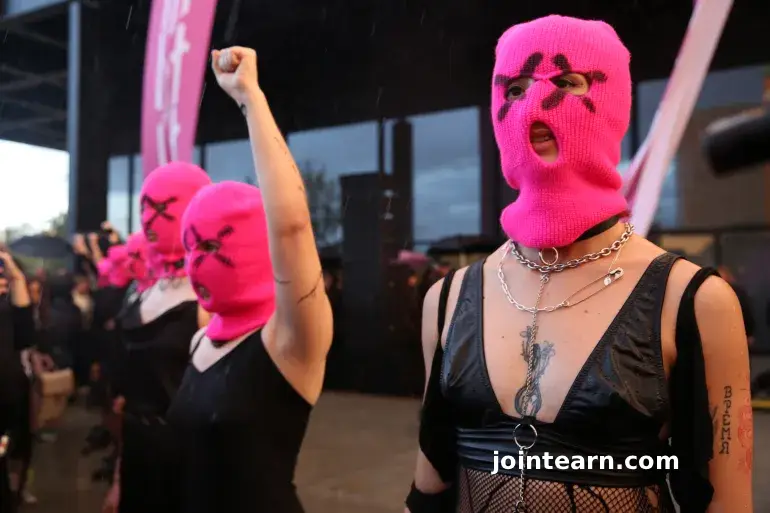
A Moscow district court has officially designated the Russian punk protest band Pussy Riot as an extremist organization, escalating the Kremlin’s crackdown on dissent and amplifying international attention on the exiled group. The ruling, reported by state news agency TASS, has sparked defiant responses from the band members, who remain vocal critics of President Vladimir Putin.
Court Ruling and Legal Background
The decision came after the Russian Prosecutor General’s Office filed claims against the band, with the court ruling delivered in a closed session. According to AFP, the court upheld the prosecution’s request “to recognize the punk band Pussy Riot as an extremist organization and ban its activities on the territory of the Russian Federation.”
Leonid Solovyov, the band’s lawyer, confirmed plans to appeal the ruling. He emphasized that despite the legal designation, the group continues to operate in exile and intends to challenge the decision through all available legal avenues.
Pussy Riot’s Response
In a defiant statement posted on their verified social media accounts, Pussy Riot described themselves as “proud extremists,” asserting that their designation highlights the Russian government’s intolerance for dissent.
The band declared:
“In today’s Russia, telling the truth is extremism. So be it – we’re proud extremists, then.”
They directly criticized Putin, calling him “an aging sociopath spreading his venom around the world like cancer,” and emphasized that members living in exile are “freer than those who try to silence us.”
The ruling significantly increases the risk for supporters inside Russia. According to the band, possession of their music, videos, or even wearing a balaclava associated with their performances could potentially lead to legal consequences.
Historical Context of Pussy Riot’s Activism
Pussy Riot first gained international attention in 2012 when members performed a protest at Moscow’s Christ the Savior Cathedral, delivering a punk prayer entitled “Mother of God, Cast Putin Out!” The performance led to the arrest and imprisonment of band members Nadezhda Tolokonnikova and Maria Alyokhina, who served two-year sentences for hooliganism before being released under a 2013 amnesty.
The band has continued its activism in exile, notably performing at international events, including the 2018 World Cup final in Moscow. They have remained vocal critics of Russia’s political system and military actions, particularly the ongoing war in Ukraine.
Recent Legal Harassment
In September, a Russian court sentenced five individuals linked to Pussy Riot—including Maria Alyokhina, Taso Pletner, Olga Borisova, Diana Burkot, and Alina Petrova—for allegedly spreading “false information” about the Russian military. The band and the convicted individuals have consistently argued that these charges are politically motivated.
Mediazona, a news outlet founded by Alyokhina and Tolokonnikova, continues to document verified Russian military casualties in Ukraine. According to the outlet, over 153,000 names have been confirmed, each supported by evidence, context, and documentation, demonstrating the group’s commitment to transparency despite government opposition.
Implications of the Extremist Label
The designation of Pussy Riot as an extremist organization allows Russian authorities to crack down on the band’s supporters and curtail their influence within Russia. Experts warn that the ruling is intended to erase the band’s presence from public consciousness, making even minor associations with their work potentially punishable by law.
The case underscores the broader pattern of suppression of dissenting voices in Russia, particularly those using art and activism to challenge political authority. International human rights organizations have condemned the ruling, framing it as part of a continuing campaign to silence independent activists.
Conclusion
Pussy Riot’s designation as an extremist organization marks a critical moment in Russia’s ongoing struggle between state control and activist expression. Despite legal pressures and the risk to their supporters, the band remains steadfast in their criticism of Putin and dedication to political art. Their story continues to resonate globally, illustrating the power of music and performance as tools of resistance against authoritarian regimes.


Leave a Reply