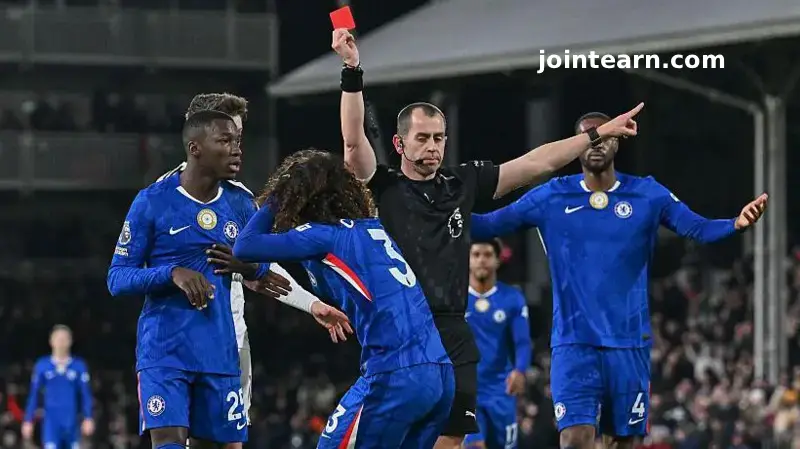
Football’s law-making body, the International Football Association Board (IFAB), is preparing to review several significant rule changes that could reshape the game as early as next season. Topics under discussion include expanded red card criteria, VAR intervention rules, offside law adjustments, time-wasting measures, and goalkeeper behavior, with potential implications for both domestic leagues and the upcoming FIFA World Cup.
The discussions will take place at IFAB’s annual business meeting in London, with final approval expected at the Annual General Meeting in Cardiff on 28 February. Any approved changes would officially come into force on 1 July, though some could be implemented earlier at international tournaments such as the World Cup.
How IFAB Decisions Are Made
IFAB consists of FIFA and the football associations of England, Scotland, Wales, and Northern Ireland. Each UK association holds one vote, while FIFA has four votes. A minimum of six votes is required for any law to be changed.
Once approved, new laws apply worldwide across domestic leagues and international competitions.
Red Card Rules: Denial of Obvious Goalscoring Opportunity (DOGSO)
Proposed Expansion of Red Card Criteria
One of the most notable proposals involves expanding the definition of Denial of an Obvious Goalscoring Opportunity (DOGSO).
Currently, a defender can only receive a red card if the fouled attacker themselves had a clear chance to score. IFAB is now considering whether team-mates’ scoring opportunities should also be taken into account.
What Could Change?
- The phrase “location and number of attackers” may be added to DOGSO considerations.
- A red card could be issued if a foul stops a player who could have passed to a team-mate in a clear scoring position.
- This would especially apply to fast counter-attacks, where stopping one player may deny a certain goal for another.
If approved, more defenders could see red cards in situations where a foul halts a promising attacking move, even if the fouled player was not through on goal.
DOGSO and Advantage: Yellow Cards May Be Removed
Another proposal would remove the mandatory yellow card when a DOGSO offence occurs but advantage is played and a goal is scored.
At present, a player can still be booked even if the attacking team scores. Under the new proposal, referees would not issue any card in such situations, recognising that the goal itself restores fairness.
Offside Law Changes: Wenger’s “Daylight” Rule Likely Rejected
Why Wenger’s Proposal Is Being Sidelined
Former Arsenal manager Arsène Wenger has long championed a “daylight” offside rule, which would allow attackers to be onside if any part of their body is level with the defender.
However, IFAB is expected to move away from this idea, citing concerns that it gives too much advantage to attackers and places defenders at a disadvantage.
A New Alternative: Torso-Based Offside Decisions
Instead, IFAB will discuss trialing a “torso offside” system, where:
- Offside decisions are judged using only the upper body
- Arms, hands, and feet would no longer be used for tight decisions
This approach is considered more balanced and easier to officiate. Trials are likely to begin at youth levels before any senior adoption.
Goalkeepers and Tactical Timeouts: A Growing Concern
The Problem of Feigned Injuries
A growing trend in modern football sees goalkeepers going down injured during key moments, allowing their teams to regroup and receive instructions from the sidelines.
Since goalkeepers are exempt from the rule that forces outfield players to leave the pitch after treatment, referees currently have no power to penalize this behavior.
IFAB’s Proposed Solution
IFAB is considering:
- Forcing teams to temporarily remove an outfield player if a goalkeeper receives treatment
- Trialing longer mandatory time off the pitch for treated players
Some argue this unfairly assumes goalkeepers are cheating, but IFAB agrees that action is needed. Any changes would first be tested at lower levels.
Longer Time-Off Trials Already Underway
- FIFA recently tested a two-minute exclusion at the Arab Cup
- Major League Soccer already uses a similar rule
- The Premier League is reportedly opposed to extending the current 30-second limit
VAR Changes: Corners and Second Yellow Cards
VAR and Corner Decisions
VAR currently does not review corner decisions due to concerns about delays. However, FIFA believes corners can be checked quickly before they are taken, avoiding time loss.
FIFA is seeking special approval to use VAR for corner decisions at the World Cup, potentially setting a precedent for future competitions.
VAR for Second Yellow Cards
There is broader agreement on allowing VAR to review second yellow cards that lead to a red card.
However:
- VAR would not review potential second yellow offences before they are given
- This avoids excessive stoppages and constant reviews
Tackling Time-Wasting: Throw-Ins and Goal-Kicks
Countdown Timers Could Be Introduced
Following the success of the eight-second goalkeeper holding rule, IFAB is exploring countdowns for:
- Throw-ins
- Goal-kicks
If the timer expires:
- Possession would switch to the opposing team
- A delayed goal-kick could result in a corner for the opposition
These rules would initially be trialed in lower leagues.
MLS-Style Substitution Rules Under Review
IFAB is also considering adopting Major League Soccer’s Timed Substitution Rule, which:
- Requires substituted players to leave the pitch within 10 seconds
- Delays the substitute’s entry by 60 seconds if the rule is ignored
Jewellery and Accessories: Taping Could Be Allowed
Current rules ban all jewellery, even if safely taped. IFAB is now debating an exception for:
- Items that cannot be removed
- Accessories that can be securely covered
If approved, players would be allowed to participate provided there is no safety risk.
Other Law Changes Likely to Become Permanent
IFAB is expected to formally adopt:
- “Only the captain” communication rule with referees
- Clarification of the double-touch penalty rule
Under the clarification:
- A penalty scored after an accidental double touch results in a retake, not a free-kick for the opposition
Conclusion: Big Changes Ahead for Football
From red cards and offside laws to VAR authority and time-wasting controls, IFAB’s upcoming review could lead to some of the most impactful rule changes in recent years. While not all proposals will be approved, the direction is clear: improving fairness, flow, and clarity in the modern game.
Football fans, players, and referees alike will be watching closely as the laws of the game continue to evolve.


Leave a Reply